My friend Meredith Britt is among the artists taking part in the Second Invitational New Mexico Painters Exhibition at Kennedy Hall on the campus of New Mexico Highlands University. The show will be up beginning Sept. 6 and run through Oct. 16, with the reception to be held from 4-7 p.m. on opening day.
Meredith is one of my favorite people. I thank her for kindly answering my questions and allowing me to feature her in this blog about the show. Her dry sense of humor makes me smile; her work lets me know how important art is to her.
She said about painting: “I’ve always painted. I’ve considered painting my main focus since I was 29 when I went back to school and changed my major to art.
“‘Formally trained’ sounds like I’m housebroken, which I am. I’ve been to obedience school too,” she replied to the question about whether she is self-taught. “Art kind of teaches you, whether you’re in school or not. As long as you’re making art, art is the teacher.”
In addition to painting Meredith does beautifully created collage art in vibrant colors with amazing detail. “I got started with collages just playing around with colored paper and glue stick when we had the Community Art Center by the bridge. Both mediums are so malleable – you really can’t go wrong. The artist always gets to play god.”
She refers to the artistic style of her painting and collages as Britt Realism. I can see that. There is subtle simplicity and power in her work.
Of the five bold-image paintings she submitted for consideration, three were chosen.
“The pieces I picked for the show sort of go together because they are all large-scale still lifes: an ice cream cone, a toaster, and a thermos with two cups and saucers. They all sort of relate to food so there’s another thread. I also entered a painting of a chair and one of the women’s room in the Highlands art building. Those didn’t get in. Maybe the curator was hungry. On another note, I seriously hope my work gives people some joy or helps them remember there’s a bigger picture. Nothing is as it seems.”
I asked Meredith what three things she wanted people to know about her as an artist.
“I want people to know that I believe art is everything; that I hope to inspire others to make art without judgment; and that I no longer think about the fact that I’m the world’s greatest artist.”
Meredith’s work can be seen at el Zócalo Gallery, 1809 Plaza in Las Vegas, an art space she is proud to share with others.
“Eleven of us members own it cooperatively. It’s one of the best things that ever happened to me. It’s a beautiful place and we all get along well. Everyone is invited to come see us – we’re open every day. I’ve been in galleries in Santa Fe and Taos, but I don’t need them now that I have el Zócalo.”
For more information about the Second Invitational New Mexico Painters Exhibition at Kennedy Hall, click here to read an article by Margaret McKinney.
What: Second Invitational New Mexico Painters Exhibition at Kennedy Hall Where: Kennedy Hall Art Gallery Dates: Sept. 6 – Oct. 16 Opening Reception: 4-7 p.m., Sept. 6 Cost: Free
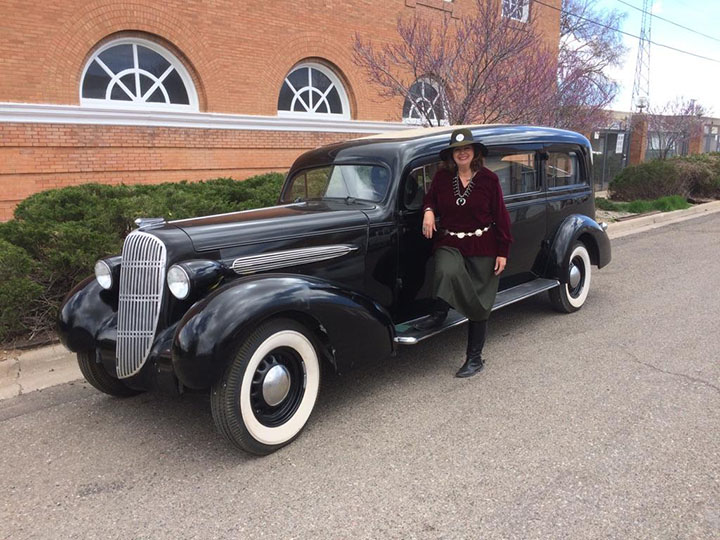
Southwest Detours owner Kathy Hendrickson stands in front of a car similar to the types of vehiciles the Indian Detour Couriers used to transport tourists into Indian Country.
The bustle of waitresses, the hum of conversation, and the clatter of dishes serve as background music as Kathy Hendrickson rushes into the restaurant for an interview about her new business, Southwest Detours. She has dramatic flare and while she isn’t wearing her Indian Detour costume, it’s easy to picture her in it: a burgundy Navajo-style velvet shirt, long dark green skirt, and silver Concho belt, boots, and a dramatic wide-brimmed dark green hat with a bronze hatband sporting the official Indian Detour silver badge. Her attention to detail lends authenticity to her presentations as a tour leader. And she loves the look.
Like restaurateur and hotelier Fred Harvey, Hendrickson is a natural born entrepreneur. She has a knack for talking to people and connecting with them. She also knows it takes more than having a knack for working with people to be successful. Being well prepared is essential.
“Allan Affeldt started the ball rolling by asking me to organize the Las Vegas Harvey Girls (like he has at the La Posada with the Winslow Harvey Girls), and do the tours. I took it to the next level, you could say, by starting my tour business,” Hendrickson said.
“Allan asked me to do tours at his two properties, Plaza Hotel and Castaneda Hotel. I had a conversation at the UWC to promote and do tours there. We started out calling them Harvey Girl Tours, but later put the tours all under the umbrella of Southwest Detours, which made better sense, since I do a lot of the tours on my own. When I have groups with 10 or more folks, I call on a Harvey Girl to help, or if someone requests a Harvey Girl to go on the tour.”
Harvey Girls and Detour Courier Hendrickson
The Castaneda and Montezuma Castle were Fred Harvey properties back in the day, and both used the services of Harvey Girls, dignified young women who were prim and proper, efficient, and dependable. The uniform of crisp black dresses with starched white accents at cuff and collar, and overlaid with a white apron, sent a clear message that the customer was first and service was paramount.
Hendrickson said she loves the Harvey Girls and the role they played in history. “They are charming, but that persona didn’t speak to me. And then I found out about the Fred Harvey Indian Detour Couriers. Now that appealed to me!
“Fred Harvey started the first chain of hotels and restaurants with an emphasis on quality and service. When train travel was slowing down in the early part of the 1900s, the Harvey Company began to explore ways to get people to the Southwest. The company promoted tours for railroad travelers that allowed them to leave the train and take tours into Indian Country. In 1926 the Indian Detours Company formed. It was only around for about ten years, but in that time the couriers – all highly trained and well-educated women – took thousands of people on adventures all over the Southwest. I looked at that history, that costume, and said, ‘That’s what I want to be!’”
Hendrickson officially launched Southwest Detours in March, and has already shepherded nearly 400 guests through the three historic properties. And she is just the person you want to lead your tour. She starts with scripted talking points, but does everything she can to make your tour unique and entertaining.
“I have two kinds of people on tours,” she said. “Most are not historians, but some are pretty knowledgeable. The knowledgeable guests sometimes ask questions I can’t answer despite all the research I have done. I like those questions. They help me add more to my knowledge base. I do a lot of reading and I’m always adding new information to keep the lectures fresh. I don’t want to say the same thing all the time, and I want to make sure what I do say is factual.”
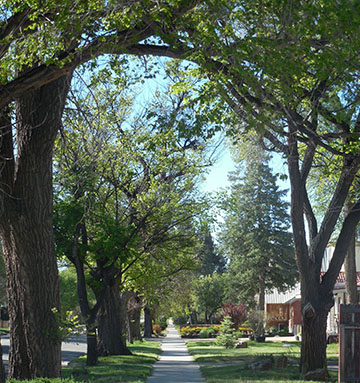
Hendrickson is learning the business one day at a time. She has had a few surprises, but is not deterred. “I want to expand out and do tours in the surrounding area, but right now I’m putting my emphasis on Las Vegas. It’s more than going from one property to another. I talk about the history of Las Vegas, and take guests around to the neighborhoods where there are Victorian homes. I usually have one or two Harvey Girls with me when I have a group of ten or more. I’ve only lived here three years, but guests like it when someone like Martha Johnsen (a Las Vegas native and Harvey Girl) is along. She can fill in with what it was like growing up here.” Other members of the Las Vegas Harvey Girls in addition to Johnsen are Dee Clark, Becky Johnson, Virginia West, and Pam Buethe.
As the Detour Courier and company owner, Hendrickson – in addition to leading tours – is responsible for booking groups, overseeing development of the company, and creating interesting presentations. She said her affiliation with CCHP as a board member and volunteer has been valuable.
“It is through the CCHP archives and resources at the World College that I have learned new information about these properties and Las Vegas. It gives me more to talk about,” she said.
“After a recent tour Martha pointed out that we are like ambassadors for Las Vegas. And she’s right. We bring people to town, usually they stay over, eat in our restaurants, shop in our stores, and leave with a good feeling about Las Vegas. You can’t beat that!”
Kathy and Bill Hendrickson moved to Las Vegas after visiting here over a four-year period. “Bill wanted to live in a small town in Northern New Mexico. I wanted to live in a small town and close to Santa Fe. Las Vegas is perfect and we love it.
“Owning a tour business allows me to expand to other places in and around Las Vegas, but I do focus on Las Vegas since that’s what most folks want to tour. The Castaneda Hotel, Montezuma Castle and Plaza Hotel are the most requested.”
Southwest Detours’ subhead is, “Your Pathway to Adventure.” For your adventure contact Hendrickson at505-459-6987, or e-mail info@southwestdetours.com. Tours vary in size from three to four people, up to a busload of 50. Fees available on request.
Thank you for being a reader/subscriber. It is my goal to present informative, interesting and creative content on this site. Your likes, shares and comments are welcomed and hugely appreciated.
Bedraggled and empty,
her worn gables sagging
like an old woman’s wig,
askew and tatty.
Behind a scarred oak door
a dull wooden staircase,
marred wainscoting,
wallpaper stained and torn.
Oh, but the memories
that sing through her halls
telling of family history
full of laughter and joy.
Now restored, rainbow hues
dabbed on lintel, column,
dormer, cornice, pediment
and wraparound porch.
Oak door burnished to a shine,
beveled glass winking with light,
floors polished and golden,
the lady comes to life.
History begins anew
in the painted lady,
Victorian character and charm
dancing with memories made.
______________________
Thank you for being a reader/subscriber. It is my goal to present informative, interesting and creative content on this site. Your likes, shares and comments are welcomed and hugely appreciated.
Let us stroll along today
and talk.
Tell me what makes you laugh
as we walk.
I want to listen to what
you have to say.
Share your heart with
me today.
I want to know what makes
you cry.
May I ease your worry and wipe
your tears dry?
Share with me your anger
deep inside.
I will help you slay that dragon,
and turn the tide.
I am your friend
come what may.
Please share your heart
with me today.
________________________
Thank you for being a reader/subscriber. It is my goal to present informative, interesting and creative content on this site. Your likes, shares and comments are welcomed and hugely appreciated.
Shadow fingers stretch to touch
velvet cups on slender stalk–
Dance! whispers nature
‘ere sun makes each shadow walk.
Thank you for being a reader/subscriber. It is my goal to present informative, interesting and creative content on this site. Your likes, shares and comments are welcomed and hugely appreciated.
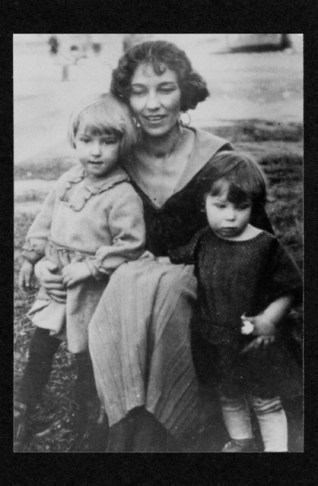
Ron’s blond Aunt Sue, his grandmother Ruth Adella Foster Downer, and his mother, Beverly, circa 1923
This week a parcel was delivered that was addressed to my late mother—Beverly (Downer) Querry Corbett. My mother died September 24, 2011 of natural causes in Oklahoma City, a few days before her 89th birthday.
Born October 4, 1922, in Norman, Oklahoma, to Ruth A. Downer, an Original Enrollee of the Choctaw Nation, and to Pierce A. Downer, my mother spent much of her early childhood on my grandmother’s allotted land near Newcastle, Oklahoma. Our family always called it “Choctaw Place.”
The parcel was accompanied by a letter from Chief Gary Batton. In it, Chief Batton honored my mother for her years of wisdom and her service with a beautiful “Wisdom Blanket.” I speak for her three children when I say that our mother was always proud of her Choctaw heritage and would have been deeply moved by this tribute.
I believe that my mother would have liked you to know about her family—to know things that should be remembered. I believe she would have asked me, as her eldest son, to tell you.
Listen:
It was, I suppose, in first or second grade that I was first required to commit to memory and to recite the Pledge of Allegiance, the Lord’s Prayer, and the names of the Five Civilized Tribes. Only later did it occur to me that not every young scholar in the United States was so well versed in exactly which five tribes were deemed “civilized” as were my classmates and I at Andrew Johnson Elementary in suburban Oklahoma City. I assumed that fresh young people all across America pledged and prayed and chanted “Choctaw, Chickasaw, Cherokee, Creek, Seminole” just as proudly and as loudly as did I.
I am very light-skinned—over the past couple of decades I have spent a good deal of time and money having skin cancer and pre-cancerous lesions removed, mostly from my face. My hair color has transitioned from orange (when I was born, I’m told), to white-blond (as a kid reciting things in elementary school), to reddish-brown (high school and Marine Corps), to raccoon-like multi-colored, to gray. (I do not mind that my hair is gray. A former Principal Chief of the Choctaw Nation told me once that I shouldn’t mind what my hair turned, just as long as it didn’t turn loose.) My eyes are blue.
To see a photograph of my mother as a young girl you would not likely question her Indian-ness. The same applies with increasing certainty to my grandmother, to her father, to his father (the latter I understand to have sported braids and, when astride a horse and under the influence of strong drink which was not unusual, would frighten women and children—and while that story may not be entirely accurate, I hope that it is), and, I trust, on back to a Choctaw woman named Otemansha, peace be upon her.
The Dawes Commission was organized in 1893 to establish a Roll of American Indians residing in Indian Territory between 1899 and 1907.
My late grandmother Ruth Adella Foster is listed Number 15,137 as of March 26, 1904, on the Dawes Commission Rolls as an “Original Enrollee” of the Choctaw Nation of Oklahoma. As are her father and her two older brothers—her mother is enrolled as an “I.W.” or “Intermarried White.” My grandmother had a younger brother who was born after the Rolls had closed and so, to his eternal dismay, was not considered an Original Enrollee. E.A. Foster, Jr., was his name—we knew him as “Uncle Manny”—and he researched exhaustively the Foster family lineage, to wit:
My four-greats grandmother was referred to generally in documents I possess as, “the Choctaw woman, wife of William Foster” in Mississippi. In a couple of documents of court proceedings, she is called “O-Te-Man-Sha,” which I presume was a phonetic attempt to spell her Choctaw language name.
Otemansha was of the “Sixtown” Tribe or Clan of Choctaw Indians. Oklahoma Historian Angie Debo says that “Sixtown Indians, Okla Hannali, spoke a distinctive dialect, tattooed blue marks around their mouths, and were shorter and heavier in build than the other Choctaws.” (Debo, The Rise and Fall of the Choctaw Republic, 1934, p.20)
When Andrew Jackson determined that the Southeastern Tribes should be removed from their homelands to what is now Oklahoma, so as to better facilitate the white folks who wanted more land, it was the Choctaw Tribe that was chosen to be among the first to go on what they called The Long Sad Walk. Those upstart Cherokees with their Trail of Tears came later. I understand that the Choctaws were chosen to be the first removed because they were deemed least likely to protest—they had already begun to assimilate and there were farmers and store-keepers and teachers among them.
There were, to be sure, different levels of assimilation. I remember one of my uncles telling about how our Choctaw ancestor, Otemansha, had held an important position in the Sixtown Clan back in Mississippi—that she had been a “Bone Picker.” At the time I didn’t know what a Bone Picker was and I don’t recall that my uncle told me. Had he done so, I feel certain that as a young boy I would have remembered so gruesome were the duties of that high office in Choctaw culture. If Otemansha were a “Bone Picker,” she was, indeed, an honored person and would have performed important duties in the funerary practices of her community at the time. She would likely have had distinctive tattoos that identified her position and her thumb and index fingernails would have been long and thick. For when a Choctaw Indian died, he or she was wrapped securely in robes and placed upon a wooden scaffold near the house and left to rot for a number of months. When the appropriate time had passed the “Bone Picker” came and removed what flesh remained on the deceased’s bones by using his or her fingernails. The bones were then placed in boxes and stored in a “Bone House” until such time as there were enough bones from the community to bury in a mound. To be sure, I have no real evidence that I am descended from “Bone Pickers”—only a story told by a long deceased uncle. But I hope the story was true. I like thinking of this woman without whom I would/could never have been born—I like thinking about her place in her community.
In preparation for Removal, in September of 1830, at a place near what is now Philadelphia, Mississippi, the making and signing of the Treaty of Dancing Rabbit Creek took place. The Choctaw tribe ceded almost eleven million acres and agreed to remove to Indian Territory in what is now Southeastern Oklahoma. Among the nearly two-hundred signatories of that Treaty appear the signatures of my ancestors, brothers William and Hugh Foster, and the “X” of their brother Thomas.
Choctaws who wished to remain in Mississippi were offered 640 acres of land and Mississippi citizenship if they would sign up with Indian Agent William Ward. Colonel Ward, as it turned out, was not an honest man. When the deadline came for signing on to what is known as Ward’s Register, only sixty-nine heads of Indian families had done so. Otemansha was one of thirty full-blood Indians to sign; her sons James, William, and Hugh Foster (the latter two having also signed the Dancing Rabbit Creek Treaty, you’ll recall) were three of twenty-four so-called “half-breeds”; fifteen of the signers were white men with Choctaw wives. (Clara Sue Kidwell, The Choctaws in Oklahoma)
Possibly owing to the fact that traditional Choctaw people, when they moved or relocated, were bound by tradition to take the bones of their ancestors with them, Otemansha refused ever to leave her Mississippi home, as did her son James, who is my three-greats grandfather. James died in Mississippi in 1833 at about the age of twenty-eight. Otemansha died some four years later and is buried near the Pearl River. Hugh Foster was reportedly “killed by a white man” and is buried at Skullyville, Oklahoma.
The Treaty of Dancing Rabbit Creek, which was ratified by Congress February 25, 1831, promised, among other things, autonomy of “the Choctaw Nation of Red People and all their descendants [emphasis mine]” to be secured from laws of U.S. states and territories forever.
I like knowing that I am a direct descendant of a woman who may have used her fingernails to scrape clean the bones of dead people.
–Ron Querry
___________________________________
Ron Querry is a renowned author of two novels about contemporary American Indian life in the southwest, non-fiction works, and countless articles in magazines and newspapers. He may be reached at rquerry@gmail.com
 My friend Meredith Britt is among the artists taking part in the Second Invitational New Mexico Painters Exhibition at Kennedy Hall on the campus of New Mexico Highlands University. The show will be up beginning Sept. 6 and run through Oct. 16, with the reception to be held from 4-7 p.m. on opening day.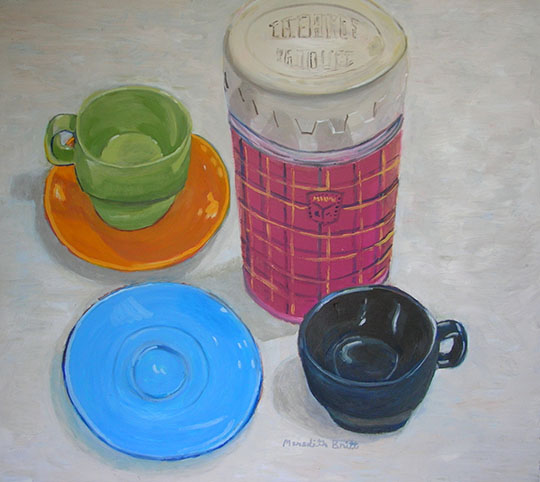






 Sharon Vander Meer