In Seven Wings to Glory, author Kathleen M. Rodgers tells a layered story of life as we know it. It’s rarely simple and often riddled with secrets and surprises. Rodgers’ latest book explores loss, racism, forgiveness, and hope.
Protagonist Johnnie Kitchen uses her dream job as a newspaper columnist to bring to light long buried racially charged secrets, including the lynching of an innocent black man. She tells hauntingly and beautifully about the spirit of forgiveness as seen through the lingering presence of victims who died tragically in a long-ago fire that an all-white fire department refused to respond to.
When prejudice again rears its ugly head in Johnnie’s small home town of Portion, Texas, she is appalled and infuriated. Despite worries about her soldier son in Afghanistan, she sets out to right the wrongs of a brutally insensitive teen with an attitude. What she finds is the troubling reality of his life as a neglected and emotionally troubled victim of family dysfunction. With compassion and determination, Johnnie teams up with others to help reshape the life of someone who grew up in a hateful and mean environment.
In Seven Wings to Glory Johnnie frets about her absent son and the dangers he faces; learns surprising news about her life, withheld by people trying to do what they considered at time to be “the right thing;” and endures pain upon the tragic death of a beloved four-legged family member.
Surrounded by people whose love is sure, if sometimes imperfect, Johnnie navigates life with determination and steadfast hope.
Praise for Seven Wings to Glory:
Seven Wings to Glory “masterfully weaves the story of the Kitchen family, capturing a vivid snapshot of the American South.” – Eastern New Mexico News
A nuanced portrayal of military connectedness… Rodgers writes convincingly of relationships, foibles and struggles. Johnnie’s worry over her son is particularly tangible, informed by Rodgers’ experiences as the mother of a deployed soldier. – Stars and Stripes
Rodgers’ first Johnnie Kitchen book, Johnnie Come Lately, received First Place in Women’s Fiction for 2016 Texas Association of Authors Best Book Award Contest, a gold medal in the Military Writers Society of America 2015 Book Awards, and a bronze medal in the Readers’ Favorite 2015 Book Awards–Women’s Fiction Category.
The author lives in a suburb in North Texas with her husband, a retired fighter pilot/commercial airline pilot. Her youngest son is a former Army officer who deployed to Afghanistan in 2014. Her first novel, The Final Salute, takes place on an air force base.
Seven Wings to Glory, $15.95, is a work of women’s contemporary fiction available online and in bookstores. For more information about the author go to www.kathleenmrodgers.com .
Recognition of women’s contributions to the past and the present began in 1978 as Women’s History Week in Sonoma County, Calif. The week including March 8, International Women’s Day, was selected. In 1981, Sen. Orrin Hatch (R-Utah) and Rep. Barbara Mikulski (D-Md.) co-sponsored a joint Congressional resolution proclaiming a national Women’s History Week. In 1987, Congress expanded the celebration to a month, and March was declared Women’s History Month. After more than 200 years of American history and eons of world history, it was about time.
In the early ‘90s, when I was an associate editor at the Las Vegas Optic, in celebration of Women’s History Month I wrote a series of articles about area women. The list included a doctor, banker, forester, writer, educator and public servant. Each had quite a unique story to tell and I enjoyed the interviews tremendously.
What I most enjoyed about writing the articles was gaining a better insight into the passion these women had for whatever they did, and leaning how much they had contributed to the community. They were – and continue to be – heroes. Prior to the ‘60s women occupied a stereotypical role in society, at least on the surface, but I grew up around a mother who believed she could do anything, and did. She had her challenges, a special needs daughter among them, but she understood at gut level that the only true obstacles were the ones she created for herself.
She worked in a nurturing field, around people much like my sister, constrained in life by ailments or mental deficiencies beyond their control. She also worked with clients who had committed a crime, who were incarcerated in the state mental facility rather than in prison. Their cases warranted a second look at their ability to know right from wrong and whether they were mentally stable enough to stand trial.
Mom was a fireplug of a woman, short and fiesty, who never hesitated to stand toe-to-toe with men twice her size. She faced them down and lifted them up. Many of her clients kept in touch with her after they left the facility. As a counselor she gave them a sense of their own worth. She helped them see they were more than their circumstances.
Mom did the same for her children, encouraging us to see outside the box long before the phrase became a cliché. She was and is my hero and my role model. She died years ago, but her legacy remains. She will never be written up in a history book but her history with our family shaped who we are today, and I thank her for it.
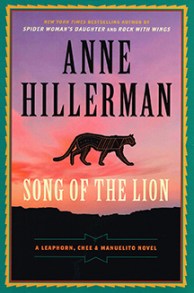
In author Anne Hillerman’s latest book, Song of the Lion, Bernadette Manuelito emerges as a savvy heroine who does her job with intelligence and wit while stoically ignoring the irritation of not being respected by a fellow officer. It is not luck or pride that motivates Manuelito, it’s doing the right thing at the right time for the right reason, including trusting her instincts in a life-threatening moment of peril.
Manuelito and her husband Jim Chee, work for the Navajo Tribal Police where facts and evidence add up to answers. That doesn’t discourage Manuelito from using her intuition and connection with old ways, or Chee from showing respect for honored traditions.
Put that cultural identity and awareness into play when the two unofficially work a case, and the result is a compelling story. A car bombing outside a school gymnasium that kills an unidentified young man sets the story in motion. Add in the complication of developers wanting to make dramatic changes on tribal lands and the groups for and against the proposal. Mix in a little sabotage designed to sideline the negotiations. Season with a surprising connection between the case and Manuelito’s friend and mentor, Joe Leaphorn. What you have are all the ingredients for a fast-paced story featuring familiar characters doing what they do best. Manuelito proves to be a dedicated law enforcement officer with an unbeatable spirit.
I recommend Song of the Lion to anyone who likes a good tale woven throughout with interesting, well-drawn characters.
Praise for Song the Lion from Booklist: “Hillerman seamlessly blends tribal lore and custom into a well-directed plot, continuing in the spirit of her late father, Tony, by keeping his characters in the mix, but still establishing Manuelito as the main player in what has become a fine legacy series.”
Hillerman is an award-winning reporter, the author of several non-fiction books, and the daughter of New York Times bestselling author Tony Hillerman. She lives in Santa Fe, N.M.
Title: Song of the Lion
Type: Novel
Author: Anne Hillerman
Publisher: Harper Hardcover
Publication date: April 11, 2017
Price: $27.99
Ron Querry should be an actor in a Western movie. He has the craggy good looks, air of romanticism and steely-eyed stare of a cowboy hero. He would scoff at such a description, but his tongue-in-cheek memoir tells a different story. Creative license aside, I See By My Get-Up reveals a man much inclined to finish what he starts, and one who learns by observation, intuition and application.
Despite growing up in an age of disillusionment and questioning everything, Querry kept on course when it came to education and earned his Ph.D. in American Studies in 1975. He spent a few years as a professor at the University of Oklahoma, and taught at Highlands, Lake Erie College for Women, and conducted seminars on Native American Literature in Italy.
Long before he entered into marital partnership with the “rancher lady” heroine of his book and his life, Querry was (and is) a cowboy. He writes that people get the impression from reading Get-Up that he lacked experience working on a ranch. “I poke fun at people in my writing—mostly I poke fun at myself. In Get-Up, I took the role of the effete university professor trying to be a cowboy in order to woo the beautiful rancher lady. This was tongue-in-cheek. I find that I often have to explain to people that my feet weren’t nearly so tender as I made them out to be. I look back now and see that for most jobs I ever took in academia, I left a ranch job.”
Querry spent summers when he was a teenager working on farms and ranches. In Mexico he rode for a year with a retired Mexican Cavalry officer who’d been on the Mexican Olympic Team in 1968. He was a horseshoer in the ‘70s, had a training stable in Santa Fe for some time, and was the director of a large Equestrian Center at a private women’s college in Ohio.
Writing has always been a part of his life. “I wanted to write from the time I learned to read. I published my first piece when I was 16—I was paid $75 for a story in the magazine section of a metropolitan Sunday newspaper.”
Querry is an internationally acclaimed author of mixed Native American and European American descent. Many of his writings depict the intersection of white and native worlds. For his official bio go to www.ronquerry.com.
ORP: You are a member of the Choctaw Nation, a teacher, a horseman, and a cowboy. Talk about how these different aspects of your life experiences influenced your writing choices. Ron: Everything is fair game when it comes to writing. That old saw that says “write about what you know” is only useful if you know something. Always it’s necessary to learn about something in order to write about it honestly and well.
ORP: How did teaching inform your writing discipline?
Ron: I cannot think of any way that the act of teaching has informed my writing. I can, on the other hand, say that my writing is informed by everything I’ve ever done, or seen, or heard . . . so maybe my teaching shows up, somehow, in my writing. But I cannot describe it.
ORP: You spent time writing articles for newspapers, some of which ended up in, “I See by my Get-Up.” How did you decide to write this book?
Ron: It was in the early 1980s and I had been teaching for a number of years at the University of Oklahoma. The publication of the anthology I’d put together—Growing Old at Willie Nelson’s Picnic—and the circle of writers to whom it had introduced me persuaded me that if I really wanted to make my way by writing—and to run with those writers I so much admired and envied—it was time to do so in whatever full-time manner I could stand. I’ve long held to the notion that it’s a far better thing to weigh in with the other players—win, lose, or draw—than it is to continue talking to oneself or others about wanting to do something—in this case, wanting to write.
I left Norman and came to live in New Mexico again. I lived in a small, adobe house on the Pecos River near Santa Rosa owned by a friend in the horse-breeding business. I helped with the horse chores during the day and typed on a manual typewriter in the evening. I read. In order to have an income, I wrote pieces for livestock publications and newspapers. I met and courted a strong ranch woman and I wrote about that fine adventure in I See by My Get-Up, which was published by the University of New Mexico Press and later by the University of Oklahoma Press.
Get-Up describes the transition from my life as a University professor to that of a full-time rancher in short vignettes, most of which had been written and published in the livestock journals and newspapers I was selling work to. The Director of the University of New Mexico Press saw one of my pieces in the Albuquerque Journal and got in touch with me to see if I’d thought about doing a book. Of course, a book was what I was aiming for, and so it was a done deal.
ORP: The book’s content is personal and mostly humorous. Toward the end, it is painful. You write about the heartless and business like way co-inheritors of Lake Ranch insisted on disposing of the property, and in effect, booting Elaine and you off the premises with little notice. Talk about the choice to write about that, and whether you were satisfied you did.
Ron: Yes, it is painful. It was many years before I could drive I-40 where it bisected the ranch if Elaine was with me.
I am by nature honest—sometimes to a fault, I suppose. I wrote that final part of Get-Up as it was happening—that part wasn’t humorous, of course, but it was part of the story. As for being satisfied with it . . . absolutely we are satisfied with it. It’s been with three publishers, so far, and has sold very well with all three.
ORP: I listened to an interview you did with an Arizona PBS station in which you talked about your first novel, The Death of Bernadette Lefthand. Describe for readers how you came up with the premise for the book.
Ron: It was 1986 and we were living in Taos. Elaine was the chief photographer at The Taos News—I was struggling to focus on a writing project and feeling relatively useless.
Listening to the radio one morning, I learned that Larry McMurtry and Leslie Silko were to give talks at Fort Lewis College in Durango, in a couple of days. I knew and admired both Larry and Leslie, hadn’t seen either since my days teaching at Oklahoma, and thought that being in touch with them and hearing their talks might give me a boost. Durango was just a couple hundred miles from Taos, and it was the fall of the year and the drive alone promised to be beautiful.
We drove up to Durango arriving about noon and got a motel room. The talks were scheduled for that evening and so we went out to explore the town. I am, by nature, unable to pass a bookshop without going in. At least I am unable to pass a small, independent bookshop—the kind of place that, sadly, has grown rare. I don’t recall much about the little, used bookshop itself, but I came upon a title by a writer/photographer friend of ours in Taos—Nancy Wood—that I didn’t know about and had never before seen. Out-of-print, the book, When Buffalo Free the Mountains, is a non-fiction account of the Ute Mountain Ute Tribe of Indians in southern Colorado, and is illustrated throughout with Nancy’s photographs. The book was a fine first edition hardcover with a dust jacket and cost, as I recall, something less than twenty dollars. Later, we returned to the motel to prepare for the talks on campus and I laid the book on the bedside table.
The talks that evening were well attended and well received. We visited with Larry and Leslie both before and after their presentations and agreed to meet the next morning for breakfast at their hotel. I remember we had a fine visit in the course of which I mentioned that Scott Momaday was just then doing a residency in Taos at the Wurlitzer Foundation and that he had told me he was working at finishing up a Billy the Kid novel. (The Ancient Child, 1989) McMurtry was very interested in this, saying he was doing a Billy the Kid novel, as well. Anything for Billy appeared in 1988.
Anyway, after the talks that evening, Elaine and I returned to our room. I was thumbing through Nancy’s book, looking at the images, two of which struck me in particular and became the inspiration for this, my first novel—my first attempt at fiction of any kind.
The first photograph showed a young Indian woman sitting in a lawn chair holding an infant on her lap. The woman is dressed in a beaded dress and her hair is done in braids. She is, it appears, at some sort of powwow or other doin’s. The caption on the photo states that the woman is Regina Box holding her infant son and that the picture was taken five months before her death.
On another page there is a photo of a young Indian man singing at a drum. He wears jeans and a down vest and his hair is in braids. The caption says he is Jim Box and that he is shown at a Bear Dance shortly before he killed his wife.
I can tell you that to this day I have never read When Buffalo Freed the Mountains. But The Death of Bernadette Lefthand began with those two photographs.
ORP: You have said you come from a family of storytellers. What is at the heart of a good story?
Ron: I wonder what I was thinking when I said that? I can’t think of anyone in my family who might ever have been considered a storyteller.
I’m not sure I know what’s at the heart of a good story. I believe I’ve managed to tell some good stories with my novels and my memoirs. And I recognize a good story when I hear/read one. But I do not believe there is a formula or any rule for making a good story. Probably that is why I have no truck with so-called “creative writing” courses or with writing groups.
ORP: Talk about your writing process. Do you know from the beginning where you intend to take a story?
Ron: I think. I stew. I pace. I make cryptic notes that you would find meaningless. I stare out the window. I talk to myself. I eavesdrop. I study. I immerse myself in the place I’m writing about.
Understand, I do not begin with an outline of any sort. I might have a very vague idea as to where I’m going with the story early on, but I listen to what the characters say and feel and do, and go where they take me. When readers tell me that they were “surprised” by something—some turn of events—in my fiction, more often than not I can tell them truthfully that I was surprised, as well.
ORP: You said in the PBS interview that you like to “discover where things are going.” Talk about what that means in the development of character and plot.
Ron: I’ve done a number of PBS interviews over the years. I suspect what you refer to was in the writing of Bernadette. I had never before written fiction. I didn’t know how to proceed, so I simply began to write with the individuals in mind who were in the photographs I described earlier—the woman with the child at the powwow and the man that I assumed had later killed the woman. My aim was to “imagine” the death of the young woman—I suppose that was the plot. My aim was always to make the characters as real as I could—that must be character development.
I will tell you that Bernadette is told through different voices. This was because I found that in the telling I would come to a point where I wanted the reader to know something that the narrator at that moment wouldn’t know. So I had to develop another voice—another character who would be able to articulate what the first character could not or would not know. And I was concerned that those different voices not be confused with one another—I sought to accomplish this though not only speech patterns, but also visually with typeface in the published book.
ORP: In the Bernadette book and in Bad Medicine, the stories are shaped by Native American culture and spirituality. What were the challenges in getting characters right so they pop off the pages and engage readers?
Ron: I’ve long been a student of American Indian culture and lifeways. In Oklahoma, when I was very young, there were Indian folks everywhere. But it wasn’t until I began to visit/live in New Mexico, that I can recall seeing “Feather Indians,” the kinds of Indians that were in movies and, later, on TV.
I probably know more about the cultures and lifeways of Navajo and Hopi peoples, Taos Pueblo and Jicarilla Apaches than I do about the Choctaw Tribe of which I am an enrolled member. The protagonist in Bad Medicine is Choctaw, but he is working on the Navajo and Hopi Reservations.
I worked very hard getting these characters right—and I believe they are right. The reader will have to determine whether or not they “pop off the pages.”
Both my novels have been translated into French and German and have never been out-of-print in Europe. In fact, both are appearing early in 2017 as “Classics” from my German publisher in both print and e-book forms. Bad Medicine has also been published in Sophia, Bulgaria, but I have never seen a copy.
ORP: How is writing memoir and nonfiction different from writing fiction?
Ron: For me they differ very little. In terms of difficulty, fiction is the most difficult for me. Probably because of my near-obsession with getting it right. People are often surprised when I say that I have done far more research for the fiction I’ve written than for any other form. If one gets something wrong in fiction—or if a reader perceives something to be wrong—one is likely to hear about it. The truest lines I have written, for the most part, are in my novels.
In the case of memoir, those individuals who are written about—family, friends—will very likely disagree and dispute what’s written (everyone wants you to write about them until you do), but the typical reader is more apt to accept it as the writer’s experience. If you want to be loved by your family and friends, it is important not to write about them.
ORP: You’ve travelled extensively and been recognized nationally and internationally for your work. How did you and Elaine end up in Las Vegas?
Ron: I’ve lived in Las Vegas off and on much of my life. My great-grandparents came here at the turn of the 19th Century and owned property in Montezuma—someone in my family has owned property here ever since. My mother gave birth to me in Washington, D.C. where she’d gone to work during World War II. She brought me here when I was three-years-old. I lived between here and Oklahoma growing up. I attended and taught at NMHU, I have a daughter who went to primary and middle school here, and attended Robertson. I worked on various ranches in San Miguel County. Work kept taking me away from this area.
Elaine has roots here—her mother was born in Las Vegas, her grandmother attended Highlands when it was a Normal College. Her grandfather George Bibb and his brother Dee Bibb came here in the 19-teens. George ranched outside Santa Rosa, and Dee stayed on here. Many Las Vegans remember Dee and his wife Mabel.
We did travel extensively throughout the American Southwest and Mexico and Western Europe. Besides New Mexico we’ve lived in Oklahoma, Arizona, and central Mexico.
When we decided some ten years ago to stop our wanderin’ ways, we wanted to come back to northern New Mexico. We’ve not regretted it for a moment.
ORP: You put together an amazing non-motorized parade that was a centerpiece for the Las Vegas Cowboys’ Reunion Centennial Celebration in 2015. Talk about why you took on that challenge and what it meant to you for it to be such a success. Was it telling a story but in a different way?
Ron: Elaine’s grandfather and uncle, George and Dee Bibb, were very much a part of the Cowboys’ Reunions in the 1920s. In 2012, Elaine and her cousin—upon learning that the first Reunion was in 1915—struck upon the idea that there should be some kind of celebration for the 100th anniversary in 2015.
We initially tried to get others involved, but, you know, it seemed so far away and involved so much . . . we ended up taking on the challenge ourselves. The focus of the Centennial evolved into five specific events: A sit-down dinner sponsored by the Highlands Foundation; a non-motorized, all-horse parade kicking off the week-long celebration; a Ranch Rodeo sponsored by the Charles R Ranch; a month-long exhibition of Reunion Memorabilia collected and curated by Elaine; and a BBQ and visit with many of the old-time cowboys who had participated in earlier Reunions.
The parade was, as you say, an amazing success. We had hoped to attract maybe 30 or 40 mounted cowboys and cowgirls to ride—we worked very hard to attract more than 115 horses and mules and horse-drawn wagons for what was one of the quietest and most dignified parades this city has seen in decades—not a single siren. The Governor and the First Gentleman rode horses, as did cowboys and cowgirls from across New Mexico and neighboring states. People came from as far away as Mississippi and as close as Las Vegas to walk the 2-mile-long parade route that traversed both Old and New Town to help make it a safe and orderly happening. We were, as you can imagine, sore from grinning at this spectacular event. Almost a year and a half later we continue to have people come up to us to talk about and reminisce about that day.
I suppose you could say that, taken as a whole, the Centennial Celebration was itself a story. I know many, many people from across the state and the Southwest spent long hours in Elaine’s exhibition studying the photographs and other memorabilia and recalling stories and people they hadn’t thought about, as they said, “in ages.”
ORP: What is the one thing you want readers to know about you as a person and as a writer.
Ron: I’ve had to deal all of my adult life with the fact that people very often think I am angry or sullen, surly or grumpy, or just unfriendly. That’s just the face I was dealt. In fact I’m just thinking and listening—making mental notes. I’m a writer, after all. And as such, you should know that I’m likely storing away pieces of what you say, of how you look and act . . .
ORP: What are you up to now?
Ron: I’m honored to have been chosen as a judge for the Texas Institute of Letters’ important Best Novel and Best First Fiction Awards for 2016. This requires me to read closely upwards of thirty novels and collections—a task that while sometimes delightful, can be tedious since entries range from important literary works to the kinds of formulaic genre fiction that I’ve never been much taken by.
At the same time, it is a task that is all-consuming, so I have had to put on hold until early in 2017 the final stages of preparing my new work for publication. The work is another memoir, this one titled “Permanent Record.” I think it’s a fun book and I’m eager to get it out there.
______________________
Photos provided by Ron Querry
My first memory of Thanksgiving was the year I ate turkey three times, once at my aunt’s, (which was okay, she wasn’t much of a cook so I didn’t overeat), once at my grandmother’s, (which was unfortunate because she was a fantastic cook and I ate too much), and finally at home where I looked at my mother’s perfect meal and almost threw up. I was five and had, as my dad said, “A hole in my toe,” meaning I ate like a horse despite being thin as a minute and small for my age.
It came about because Mom was trying to make everybody happy. She didn’t want to hurt my aunt’s feelings by not going to her house for Thanksgiving, and what woman in her right mind wants to tick off her mother-in-law? Dad, bless him, figured it would be all right, because after all, can you get too much turkey on Thanksgiving?
My aunt (Mom’s sister), liked to have Thanksgiving early so we ate at her house about one o’clock. Grandma had mid afternoon Thanksgiving meals so at about three o’clock we were tucking into a feast of turkey and all the trimmings: dressing, cranberry sauce, three kinds of vegetables including yummy sweet potatoes with mounds of marshmallows on top, two kinds of jello salad, pies and cakes up the wazoo and fruit salad with real whipped cream. It was heaven.
And then we got home and had to do it all over again. I mean, really, I didn’t want to hurt Mom’s feelings by not eating her meal, prepared with loving hands. So despite messages my brain was sending to my stomach that I’d had enough, I dug in with gusto.
It turns out you can have too much turkey on Thanksgiving.
___________________ This essay is a reprint from an e-zine I published once upon a time. Happy Thanksgiving
I’ve done several readings at Tome on the Range in Las Vegas, NM, featuring my books. Every time I do one, I’m a wreck and second-guess whether I said the right things and whether people received my reading well. On Saturday at my most recent reading and signing, my friend Jim Terr recorded portions of the readings and the following is one clip of three he will be posting. I thank those who could make it on Saturday, and to those who couldn’t, I hope you enjoy this clip. And by the way, buy the books! You can find Finding Family at Tito’s Gallery or Tome on the Range. The poetry books you may buy directly from me. Contact me at fsvandermeer@gmail.com, or order through the click buttons in the right column.
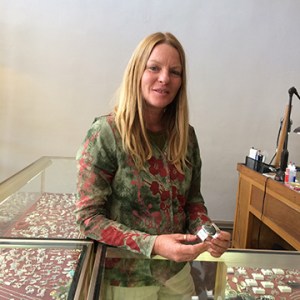
Being in business is a challenge and an opportunity all wrapped up in one great adventure. When you’re good at it, you share your expertise with others who are dipping a toe into the entrepreneurial waters. With more than thirty years of experience under her belt, Andrea Gottschalk of Unikat Fine Jewelry has grown her business and reached out to help others. She believes in working in concert with other business people and making the most of networking opportunities. She has an abundance of talent as a jewelry designer and creates a customer-friendly shopping experience as a business owner. Her insightful responses to the Q&A reveals a woman who enjoys what she does, and who remains grounded in the essentials of business ownership: making wise market decisions and operating within your means.
Andrea was born and raised in Germany. She graduated from high school in 1985 and went on a two-year world travel adventure, including an extended visit to New Mexico. She returned to Germany and attended the Goldschmiede Schule in Pforzheim. She returned to New Mexico in 1988 “for the love of it,” and started a home based jewelry business working as a sub contractor for many different retail jewelry stores in Santa Fe such as Spirit of the Earth, James Reid, Mitzi Lynn, Mahdani and many others. She made special orders and custom pieces. Andrea moved to Las Vegas, NM in 1995. “I opened Unikat Fine Jewelry in 1998 where Genesis Computers is located now. I moved across the street in 2004 to 158 Bridge St., where I had my business until September of this year.” When the opportunity came to move into a much bigger location she took it and is now operating at 160 Bridge St.
Unikat Fine Jewelry will have a Grand Opening celebration at its new location, 160 Bridge St., in conjunction with Paper Trail, 166 Bridge St. The event will be Friday and Saturday, November 11 -12.
ORP: You’ve made the move to your new location. What do you hope this will do for your customers?
Andrea: A lot more browsing room without feeling cramped in. Lots more inventory to select from. Big store windows to do window shopping, and it’s easy to find me.
ORP:What inspired you to go into business and how long have you had the store?
Andrea: I opened my first store in 1998 when Price’s Ilfeld closed their jewelry department. I was their repair jeweler for about one year and I took the business opportunity to fill that niche. I had been making jewelry since I was sixteen. I went to gold smithing school in Germany. I had always worked for other retail stores making their custom pieces. There was an important link missing for me in that I never got to have the contact with the client and never could see their joy in purchasing that piece of jewelry I had made. That was the biggest inspiration to have my own store, to have that direct connection to the client and feeling proud of what I accomplished when I would see their reactions to the finished product.
ORP:What is the single biggest challenge to being a sole-owner business and how do you address it?
Andrea: All the investments are on your own risk. All the debt you may accumulate is yours. There is no corporation that backs you up if you fail or no government that wipes your debt clean. You are solely responsible for every single decision you make and sometimes that can be very nerve racking.
ORP:What are your biggest opportunities as a business person on Bridge Street?
Andrea: The Bridge Street/Plaza area is the most well known historic area and most walked on foot by locals and tourists alike. The chance that someone will stroll by and and take a peek into your store and buy something is huge.
ORP:In addition to being a business owner, you also make jewelry and do jewelry repair. Talk about what inspires you as a business owner?
Andrea: I would have to answer that in reverse, making jewelry inspired me to become a business owner and having my own retail store. The creation of jewelry and the sales aspect of it and going more and more into designs and repairs for customers directly, taught me to have a good professional attitude with clients and subsequently has made me a good business owner. I cannot say enough how important it is to have a professional, service-oriented attitude to gain a good loyal customer base. Yes you are in business for yourself but you really work for the client and their satisfaction. If that is not understood then you better not be a business owner. Of course quality is on top of everything.
ORP:What inspires you as a jewelry maker?
Andrea: The color and shape of gemstones. They inspire the whole design and the outcome of a piece. I also love gems in their natural uncut beauty and often set them just as they are found in nature. I love combining different metals into one piece and personally I am very drawn to geometric simple shapes so a lot of my own creations have that as a component of the design.
ORP:Where do you get ideas for your jewelry designs?
Andrea: Usually when I see a gem stone that grabs me at a supplier or at gem shows, I see a whole piece of jewelry around it in my imagination. That is what I create for the most part. I really don’t sit down at the drawing table much and think a piece through from start to finish. While I create a piece the design may change in the process when I see that something works better than originally thought of. Those are usually the best pieces.
ORP: If you had a motto as a business person, what would it be?
Andrea: Know your market and don’t get in debt over your head. Don’t overspend on a huge inventory. Start slowly and built up your inventory when you can afford to invest more in it. If you create something make it top quality!
ORP: What do you like about being an entrepreneur?
Andrea: You are responsible for your own self. When something goes wrong you only have yourself to blame. If it goes right – and hopefully that’s most of the time – well, then all the credit goes to you and you feel you deserve it! It makes you an integral and meaningful part of society when you have the ability to produce something that people appreciate and cherish.
ORP:You are also active in the Las Vegas First Independent Business Alliance. Why is it important to you as a small business person to be part of an organization of this type?
Andrea: There is strength in numbers. Belonging to a business organization where everybody has the same mission, same goals, struggles and joys, you truly have a sense of belonging and you can commiserate or share the joys and successes together. You can find solutions together to common problems. Of course our top mission is our motto: Keep your money where your house is. That means to buy as much locally as you can and keep your tax dollars in town. It makes a tremendous impact on our town when the City has more tax revenue to spend. Quality of life improves for everybody by having better streets, parks, clean-up efforts, sidewalks, lighting, things for our youth and elderly to do, school improvements and the list goes on and on. People forget that all this depends largely on the revenue that comes in from tax dollars, and a huge amount is generated through our gross receipts, which is generated by shopping here locally.
ORP:Talk a little about Entrepreneurial Network and why you think it’s important.
Andrea: The Entrepreneurial Network is so important for similar reasons to why it is important to have a business organization, but with more specific multi-functions. The EN facilitator, which has been me for the past three years, functions as a one-on-one business coach where I help a start up business or expanding business in every way possible to be successful. I do that by listening to their individual needs and try to find answers to any questions they may have. This help may be through my own business experience. If I do not have the answer, I refer people to business experts in their field or to valuable programs that are being offered through the Regional Development Corporation. There is technical assistance, market research, alternative micro loans, investments through the venture acceleration fund and much more. Every business has a uniqueness to them. It is my goal to help each and every client that comes to me for help in the best way possible, and to help them succeed in their own way, to the best of their abilities. It is their own talent that they need to rely on. I help them focus on what they are good at, encourage them to build on that in their business, and remind them to not overextend themselves. If you can talk somebody out of a very bad idea and save them from a lot of trouble, then that is a success too. Every other month I have what is called the Entrepreneurial Network Forum where I invite one to three business owners to do a public presentation on their services and goods to an audience of other business owners and interested people. This is free and open to the public and is usually held at the El Fidel Hotel Wolff’s Den room. It’s a great way to promote your business and network with other like-minded people. You get updates on what is new in town and who does what, when and where. If you need any assistance with your business please call me at my store, Unikat, 425-6113. It is a completely free service and exists in four Northern New Mexico communitites: Taos, Rio Arriba, Mora and of course here in San Miguel County. It is sponsored by the RDC, Los Alamos National Laboratories and Las Vegas First Independent Business Alliance.
Andrea’s new location and contact info: Unikat Fine Jewelry
Location: 160 Bridge St., Las Vegas NM 87701 Phone: 505-425-6113 or cell 505-617-6113 E-mail: unikat@spinn.net Unikat on Facebook
____________________________
Photos: Sharon Vander Meer (Note: If you are interested in doing a Q&A on One Roof Publishing, please contact fsvandermeer@gmail.com.)
Hootie tunes and shrieking screams
scary thingies in your dreams.
On this haunted, hunted night
what next on tap will give you fright?
Creeping, leaping, jumping, sneaking
is that a ghost at whom you’re peeking?
Tiptoe back, slither down the hall
when spooky phantoms on you call.
Get into a warm and comfy bed,
pull the covers o’er your head.
Sweet visions conjure into being,
ignore the specter on the ceiling. Come out and play, he moans, Halloween lasts but a day, he groans.
Laugh, laugh away your silly fear,
the pumpkin grin will bring you cheer.
Gliding ghouls are hosts to you
waiting, waiting, and then – BOO!
_____________
Except for the photo, this is a retread from last year. The picture was taken at a hotel in Albuquerque where the employees were having a contest for the best carved pumpkin. They were all good, but this was a stand out. It’s the one we voted for :). Have a safe Halloween.
Speculation about the mind being able to move objects, influence others, and create a reality outside of human experience is the stuff writers use to great effect in novels deemed science fiction or fantasy or simply weird. The one thing we know is that the mind is complex. The little connectors in our heads fire off minute bits of information every micro-second within every second.
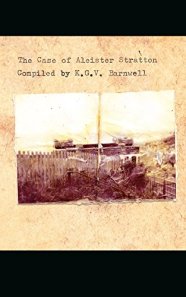
In The Case of Aleister Stratton, author and poet K.G.V. Barnwell explores how our dreaming selves may influence the course of our waking lives, especially when the dreams are devilishly bent toward revenge and retribution.
Barnwell sets the premise by identifying herself as the compiler of the story, not the writer, a reporter of events, a chronicler of someone else’s intriguing tale, one that could be told in the chill night of Edwardian England or in the modern era.
The story’s tone and style evoke a haunting aura not unlike that of Edgar Allen Poe, another poet with a penchant for writing about the bleaker side of human nature. The scholarly professor who becomes part and parcel of the ominous adventure enters into it uncertain about what he will learn and baffled by his own acquiescence, a willingness or curiosity to know why (or if?) Aleister Stratton did what he said he did.
How that revelation lives on after the Professor’s retirement causes the reader to wonder just how powerful the mind can be, and the consequence of unleashing that power. Do dark dreams lead to dark outcomes? Ask Professor Harold Richard Holland, the inheritor of the tale. He can tell you.
In a 2015 Q&A on One Roof Publishing, Barnwell described herself as an “English romantic poet and writer, living a variety of lives in and amongst the diversity and beauty of the city, sea and countryside.” This novella is a departure from her usual work, a reflection of the author’s muse seeking new outlets for her creativity and imagination.
The Case of Aleister Stratton is available worldwide through Amazon and other online book distributors.
Stop. Think for just a minute – if you can – about the worst that can happen to you. Do you believe it is some dread disease, getting hit by a semi walking across the street or finding out you’ve been betrayed? Now project that horrific thought onto someone you trust, someone you would lay down your life for, someone who has laid down their life for you… someone whose body you’re going to have to pick up piece by tiny piece to the point the only way to identify that someone is through DNA, because there’s not enough left to ID any other way.
Those are the memories Railroad Police Special Agent Sidney Rose Parnell lives with day in and day out. As an Iraq war vet whose job was working in Mortuary Affairs, Parnell returns to civilian life seeing ghosts, suffering from somewhat controlled PTSD, and generally attempting normalcy in a chaotic world.
Her problems didn’t begin in Iraq, but Iraq didn’t make them any better. Now she is faced with a mystery associated with the Burned Man, a badly wounded and scarred vet whose fiancé has been brutally murdered. Parnell, and her war-zone trained K9 partner, Clyde, are brought into the investigation by the Denver Major Crimes unit because of her particular expertise with rail riders, hobos who crisscross the country stowing away on trains. The Burned Man, the prime suspect in the murder, is a known rider and Parnell has a sense of who he is as a damaged veteran, and what he will do next.
Her investigation, complicated by an icy Colorado winter, takes her into the dark world of a savage gang of rail riders, who she believes are responsible for the death of the Burned Man’s fiancé. But there is so much more at play: a secret from her time in the military, family loyalty, and her own tarnished childhood.
This is a complex story crafted with deliberation. Sydney Rose is a heroine who doesn’t want to be thought of as such. She is admirable, tough, and takes ownership of her flawed life. She lives by her own code and with as much integrity as she can muster against odds that sometimes seem stacked against her.
Hard to believe Blood on the Tracks is Barbara Nickless’ first novel. It is indeed a page-turner that keeps you reading. The characters are people you care about, or who you can’t wait to see dealt justice, even if it’s the vigilante kind.
And this is just the beginning…
From the Publisher Barbara Nickless is an award-winning author whose short stories and essays have appeared in anthologies in the United States and the United Kingdom. An active member of Mystery Writers of America and Sisters in Crime, she has given workshops and speeches at numerous writing conferences and book events. She lives with her family in Colorado. Blood on the Tracks, which won the Daphne du Maurier Award and was a runner-up for the Claymore Award, is her first novel.
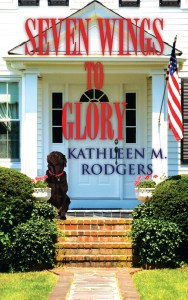 In Seven Wings to Glory, author Kathleen M. Rodgers tells a layered story of life as we know it. It’s rarely simple and often riddled with secrets and surprises. Rodgers’ latest book explores loss, racism, forgiveness, and hope.
 Recognition of women’s contributions to the past and the present began in 1978 as Women’s History Week in Sonoma County, Calif. The week including March 8, International Women’s Day, was selected. In 1981, Sen. Orrin Hatch (R-Utah) and Rep. Barbara Mikulski (D-Md.) co-sponsored a joint Congressional resolution proclaiming a national Women’s History Week. In 1987, Congress expanded the celebration to a month, and March was declared Women’s History Month. After more than 200 years of American history and eons of world history, it was about time.
 In author

 Long before he entered into marital partnership with the “rancher lady” heroine of his book and his life, Querry was (and is) a cowboy. He writes that people get the impression from reading Get-Up that he lacked experience working on a ranch. “I poke fun at people in my writing—mostly I poke fun at myself. In Get-Up, I took the role of the effete university professor trying to be a cowboy in order to woo the beautiful rancher lady. This was tongue-in-cheek. I find that I often have to explain to people that my feet weren’t nearly so tender as I made them out to be. I look back now and see that for most jobs I ever took in academia, I left a ranch job.”
 ORP: You spent time writing articles for newspapers, some of which ended up in, “I See by my Get-Up.” How did you decide to write this book?
 My first memory of Thanksgiving was the year I ate turkey three times, once at my aunt’s, (which was okay, she wasn’t much of a cook so I didn’t overeat), once at my grandmother’s, (which was unfortunate because she was a fantastic cook and I ate too much), and finally at home where I looked at my mother’s perfect meal and almost threw up. I was five and had, as my dad said, “A hole in my toe,” meaning I ate like a horse despite being thin as a minute and small for my age.
 I’ve done several readings at Tome on the Range in Las Vegas, NM, featuring my books. Every time I do one, I’m a wreck and second-guess whether I said the right things and whether people received my reading well. On Saturday at my most recent reading and signing, my friend Jim Terr recorded portions of the readings and the following is one clip of three he will be posting. I thank those who could make it on Saturday, and to those who couldn’t, I hope you enjoy this clip. And by the way, buy the books! You can find Finding Family at Tito’s Gallery or Tome on the Range. The poetry books you may buy directly from me. Contact me at fsvandermeer@gmail.com, or order through the click buttons in the right column.
 Being in business is a challenge and an opportunity all wrapped up in one great adventure. When you’re good at it, you share your expertise with others who are dipping a toe into the entrepreneurial waters. With more than thirty years of experience under her belt, Andrea Gottschalk of Unikat Fine Jewelry has grown her business and reached out to help others. She believes in working in concert with other business people and making the most of networking opportunities. She has an abundance of talent as a jewelry designer and creates a customer-friendly shopping experience as a business owner. Her insightful responses to the Q&A reveals a woman who enjoys what she does, and who remains grounded in the essentials of business ownership: making wise market decisions and operating within your means.
 ORP: In addition to being a business owner, you also make jewelry and do jewelry repair. Talk about what inspires you as a business owner?


 Speculation about the mind being able to move objects, influence others, and create a reality outside of human experience is the stuff writers use to great effect in novels deemed science fiction or fantasy or simply weird. The one thing we know is that the mind is complex. The little connectors in our heads fire off minute bits of information every micro-second within every second.
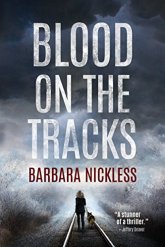 Stop. Think for just a minute – if you can – about the worst that can happen to you. Do you believe it is some dread disease, getting hit by a semi walking across the street or finding out you’ve been betrayed? Now project that horrific thought onto someone you trust, someone you would lay down your life for, someone who has laid down their life for you… someone whose body you’re going to have to pick up piece by tiny piece to the point the only way to identify that someone is through DNA, because there’s not enough left to ID any other way.
 Sharon Vander Meer