Trust – 9th Poem of Christmas

Life and Light

Truth, the word feared most of all,
Rhetoric and lies, cause us to fall.
Utmost and highest, we aspire to call,
Savior sweet Savior, ere death’s bitter gall!
Trust I give you, my life, my all.

_____________________

Ceramic Donkey, Beast of Burden Carrying Light

Faith – 8th Poem of Christmas

Bisque Nativity – Mexican Folk Art

Friend to all, enemy of none
Angels would guard Him for He is the One.
Incited, indicted some would shun
Thinking to deny Him, He would done.
He overcame all, because of Him we have won.

___________

Mexican Folk Art – Ceramic Nativity

Believe – 6th Poem of Christmas

But Tin Nativity

 Because we are watched over in all ways
Emmanuel floods hope through our days,
Lasting love, sets hearts ablaze.
Infinite praise of His miraculous birth,
Evidence of God, come down to earth.
Victory over despair, death and sin,
Enriched when through Christ, He let us in.

______________________

Cut tin Nativity. I can’t remember where we bought this set, but I like its simplicity and clean lines.

Q&A with Windy Lynn Harris: Getting Past “No”

Windy Lynn HarrisQ. In one sentence describe who you are as a writer.
A. I’m that woman peeking out from behind the pole over there, studying human behavior, sorting through the data.

Q. What is a market coach for creative writers?
A. A Market Coach is a mentor who reads your short prose and helps you figure out who’d like to publish it. I discuss long-term and short-term publishing goals with writers and point them toward the shortest route to both. I teach writers the industry standards of query letters and manuscript formatting, contract negotiation and professional etiquette.

Q. You have been a speaker at writing events. What is the most common question people ask and what is your answer?
A.
Writers who come to my presentations want to know where to send their stories and essays and poems. Luckily, there are several hundred literary magazines out there looking for writers. My favorite resource is The Review Review, an online magazine dedicated to helping writers navigate the world of lit mags. I’m the Tips editor there now, but I’ve been reading TRR since long before I joined the staff. You’ll find a searchable database under the Magazines tab and there’s also a monthly Classifieds section with calls for submissions. You’ll never run out of places to submit your prose!

Q. Where you are in your novel writing?
A.
My virtual computer drawer contains one terrible novel, two sort-of-okay novels, a pretty good novel (that came close to selling), and the second draft of a project that I think has a real shot at filling shelf space someday. The current project is a war-of-the sexes story set during a time when men and women have been separated for their own health. And it goes horribly wrong, of course.

Q. You have more than 70 bylines in a variety of magazines. What is the secret to getting a “yes” from a magazine?
A. When you send a polished piece of writing to the right editor for your prose, you’ve got a potential match. Up your chances of publication by behaving professionally. Query a specific person, for a specific reason. Format your manuscript. Follow the submission guidelines. Write your best stuff and then send it to magazines you like.

Q. How is writing for print different from writing for online magazines?
A. The lines have really blurred between these two mediums in the world of short literary writing. Online and print both offer writers a chance to be read by a wide audience.

Q. What do you wish people knew about you as a writer?
A. I get more rejection letters than almost every other writer I know. Yes, I get published a lot, but the “no thank you” bin outweighs the “yes” bin every darn month. There isn’t some magical number of bylines you need before it gets easy to publish your work. You gotta keep at it.

Q. Are you more invigorated by writing or by helping other writers?
A. I just love being in the world of writers. Many of my clients come as referrals from editors and writing instructors, but a lot of writers find me on Twitter too. Some have been writing short stories, essays and poems for years, and some are just starting their journey. Some are novelists and memoir writers who’ve been told that publishing short writing can establish a platform before approaching agents and publishers. And others are creating shorts as their primary art form. I am eternally inspired by all of the different paths available and all of the writers I get to meet.

Q. You wrote in a guest blog about taking risks (as a writer), what does that mean for you at this point in your career?
A. I’m six months into a personal challenge: write shamelessly. To me, writing shamelessly means to tell the stories that come out of me without letting that annoying internal editor stomp through my page. Some days I think I’ve mastered this skill, but then I have an attack of self-doubt. I, and my process, are still evolving.

Q. What are you working on you want people to know about?
A. Breaking news: there’s a Market Coaching for Creative Writers book in the works! I’m finalizing the proposal for that this month, and I’m gearing up for a January Market Coaching session. There are a few spots still available. Details here: www.windylynnharris.com

I’ve also got a story out in Pithead Chapel this month, and another forthcoming in Literary Mama. Just signed a contract for an anthology project with Crack the Spine that will publish this summer, and I’m gathering stories for my first short story collection. More about all that at www.windylynnharris.com.

Carols – 3rd Poem of Christmas

Carolers

Call out! Shout for joy!
Advent tells of a baby boy,
Reigning not as a regal king.
One babe in the manger, that’s the thing.
Live, love, laugh, dance, sing and shout,
Sharing His love, that’s what Christmas is about.

_____________________

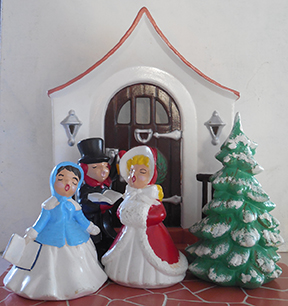
These ceramic Victorian carolers have been part of every Christmas since my son was a toddler. He’s now 42. My, how times flies. Have a blessed Christmas.

Why NaNoWriMo?

Version 2

I’ve been writing since I was able to hold a pencil. My brain sizzles with ideas and bubbles with story lines. And then I sit down at the computer. It’s like turning off a faucet. The pencil was so much more productive, a direct connect to my brain. This lapse in creativity at the computer isn’t permanent, and the ideas will begin to flow again, but will the flow end up in one bucket or flood all over  the place? I think at this point I don’t care, I’m just happy with the flow wherever it goes. For me writing is fun. At one time it was important that I be paid, and that’s nice when it happens, but the reason I write has little to do with a burgeoning bank account, which is fortunate. I’ve never made much with this gift God have me, but I continue to be enriched by it in other ways.

What does this have to do with NaNoWriMo? November is National Novel Writing Month. The website sets the stage for writing a novel in 30 days, yes, 30 days. I’ve made a smattering of attempts to do this over the years, with little success. I was easily distracted or felt intimidated by sitting down in front of the computer and knocking out 1500 to 2000 words a day to reach the 50,000 word goal. The expectation is that at the end of the month you will have the bones of a good story, which you can turn into a finished novel.

This year I am all in. I’ve already written more than 30,000 words and expect to finish ahead of schedule. Maybe. Or maybe I’ll be working on it until the last day. Regardless, I will complete the challenge, and then complete the book.

So, why NaNoWriMo? This isn’t something that happens in November and then goes away. Like a cyber muse it enters your life throughout the year reminding you to let go of your inner editor and just write. It has programs for young writers. It provides stimulus when everything else seems destined to divert you from the discipline of sitting your butt in the chair and just getting with it.

I’m half-way through the challenge, but I’m going to give a little advice on why it’s important to sign up and participate. It’s more than what you do right now, it’s how you embrace the concept and apply its strategies day after day.

Why NaNoWriMo?

  • NaNoWriMo flat out tells you to write. Period. Don’t self-edit, don’t second think, don’t curb the creative flow. Write.
  • Set goals. If you say, “I’m going to write today,” with no goal in mind, it’s easy to get distracted by just about anything you can think of, including, “I just don’t feel like writing.” Make yourself do it or you will never get anywhere.
  • During November you will get pep talks and support. It does help, believe me. There is other inspiring encouragement throughout the year.
  • The forum offers all kind of help, some you didn’t even know you needed. World building, character building, writing helps and more.
  • It is a free site. Really, absolutely free. A wealth of help and inspiration for free. I can tell you that maintaining NaNoWriMo isn’t free to the people who are doing it. Buy their stuff and donate. Help keep this fabulous thing going.

NaNoWriMo has gotten me off my procrastination pedestal and it can help you too. Sign up, even at this late date. It’s possible you can get well into your next writing project and have the satisfaction of supporting an awesome writing site.

A disclaimer here, other than participating in NaNoWriMo, I have no connection with the site builders and promoters. I just like it and want to let fellow writers know it’s there, available, and a great help.

Q&A With Lisa Ellison: Paying it Forward

Lisa Ellison headshot-1Q. In one sentence who is Lisa Cooper Ellison?
A. I’m a person who believes in the power of stories and the importance of helping others.

Q. Your bio says you come from a family where everything is communicated through a narrative arc. Talk about what that has meant to you as you make career choices.
A. I come from a family with a strong oral story telling tradition. We spent a lot of time telling tales during Sunday dinners at my grandmother’s house.  I was particularly fascinated by her ability to bring stories to life through voices, pauses, and unusual vivid descriptions.

I don’t know when I fell in love with writing, but I have many memories of sitting on my bed as a teenager composing poems or short stories. I studied creative writing while getting my bachelor’s in English, but chose to pursue jobs in the helping professions because it seemed more secure. I continued to write and read in my spare time. When I contracted Lyme disease and had to slow down, I reflected on how quickly life changes and the importance of following your passions. Deep down, I knew that writing would heal me. And, it did.

Q. I was drawn to your work by the article you wrote about your brother. It was moving, painful, and real. Talk about where you had to go inside yourself to write that article.
A. I felt led to write the article “My brother had mental health issues and committed an awful crime. But I love him,” for The Guardian, because the number of families experiencing similar losses was increasing. I wanted to join the conversation regarding mental health crises in order to help those who grieve difficult losses and to challenge some of the misguided viewpoints regarding the complexities of addressing mental health problems.

Writing the article required me to tap into the intense grief I felt regarding my brother’s death, courage to speak publicly about such a personal event, and compassion for my brother, his victim, my family, and everyone this incident touched.

Q. Your writing and blogs convey a desire to provide hope and help. Talk about why this is important to you as a writer and as one who has had to cope with illness and loss.
A. Throughout my life I’ve experienced some significant struggles, including leaving home at age 17, my brother’s suicide, and contracting chronic Lyme disease. Many people provided assistance and hope at crucial moments. Now,  I try to pay forward the gifts I’ve been given. Writing is an effective tool for transmitting hope.

Q. I am intrigued by your description of the book-length memoir you are working on. Tell briefly the premise of the book and why you were inspired to write it.
A. I contracted a debilitating case of Lyme disease, which was complicated by an MTHFR gene mutation, at age 38, the same age my mother was when she became disabled by a fall at work. She struggles with a variety of complex health conditions including lupus, gastro paresis, and rheumatoid arthritis. Her mother retired at 58 and also struggled with unexplained symptoms and diseases, as did her mother before her. After leaving home I was compulsive about my health and determined not to get sick like them. But then I did. When I found out that part of the problem was in my DNA, I knew it was time to write a book.

This memoir takes place in Elmira, New York, a town devastated by massive flooding during Hurricane Agnes in 1972.  The place never recovered, which makes it an apt setting for a memoir about seeking higher ground. On a microcosmic level, the story is a coming-of-age tale about my life in two households—one with my grandmother who never let me leave the house and one with my mother who had a more free-range approach. On a macrocosmic level, it’s a story about the jobs and opportunities that receded with the floodwaters, leaving behind a murky world where unemployed fathers looked to the local prison for opportunity, mothers joined the workforce, and everyone had their desperate and beautiful ways trying to find hope.

Q. What is mindfulness-based writing, a writing discipline you teach?
A. Mindfulness-based writing is a practice that helps writers silence their internal editors, generate more work, and tap into their authenticity. It combines mindfulness meditation, free association writing, and the sharing of unedited work, which often contains kernels of the writer’s deepest truths.

Q. Other than financial, in what ways is being an editor rewarding and satisfying.
A. There’s something magical about helping writers find their voices and develop their ideas into something that adds to the larger conversation about our world.

Q. You are in remission from a mini-bomb of illnesses that led you to create the Body Inflamed website. What has this meant to your healing, and what reactions have you had from readers?
A. During the throws of my illness misery, I made a promise to myself that I would help others if I got well. Body Inflamed is my way of fulfilling that promise. I’m amazed by the courage I’ve seen from writers who contribute to the Messages of Hope section, and the words of encouragement and gratitude I’ve received from those who also struggle with chronic illness. People struggling with chronic illnesses have incredible perseverance, though they are often underestimated. It’s part of why I want to celebrate their voices.

Q. In what ways has writing changed who you are, or has it?
A. Writing helps me make sense of the world and myself.  If anything, writing allows me to be my authentic self.

Q. As a freelance writer, what is the best advice you can give other writers about getting published?
A. • Read and write a lot
• Understand your intentions for writing a story or article. Once they’re submitted, they belong to the world.
• Treat your subjects with love and kindness
• Expect to get rejected A LOT
• Don’t take rejections personally—they may not be a reflection of your work
• Stay humble and be willing to revise one more time
• Always meet your deadlines
• Treat editors with the utmost respect.

Q.  What are you currently working on and how can readers reach you online?
A. I’m working on second draft revisions for my book and a few short essays. I also provide editorial feedback on essays, short stories, and book-length projects  and co-facilitate a mindful writing group.

There are three  ways to contact me:
·      Check out my website: www.lisacooperellison.com
·      Send me a message through the contact page on my website.
·      Join me on twitter @LisaEllisonspen

Q&A With S.L. Shelton: Influence by Creativity

S.L. Shelton, AuthorQ. In one sentence, who is S.L. Shelton as a writer?
A. S.L. Shelton is a soldier, wrapped in a tech, inside a writer; there is no fiction, only exaggerations.

Q. You are a prolific writer and active blogger. How do you schedule time for both?
A. It’s difficult when both need to be done. But for the most part I only blog between writing on the novels. Blogging is a good way to network and to satisfy my need to write when I‘m not pounding out a first draft or crawling through the carnage of a developmental rewrite.

Q. At what point did you think, “Enough of being a techie I think I’ll go for a more risky way to earn a living and become a writer?”
A. I sold my tech company a few years ago. My intent was to farm and build heirloom furniture going into my early retirement. But an unfortunate incident with a Frisbee and weak ankles left me sitting in the house for an extended period of time. I have always been a writer, but the freedom of unlimited time and enslavement to a damaged foot conspired to give me this opportunity. I’m grateful for it every day.

Q. In what ways has writing satisfied or fulfilled you as a person?
A. Well if it weren’t for writing, all these voices in my head might start getting violent… I’d rather not have to deal with that in the pharmaceutical realm. Honestly though, creativity and influence go hand in hand. It’s an odd combination to simultaneously be introverted enough to create universes in your mind, but want to move the minds of the masses. There are few other mediums that do that as well as writing and it satisfies both those desires very well if one is attentive and reflective at the same time.

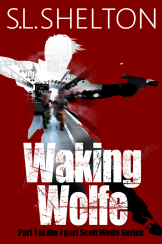
Q. You’ve had a variety of experience. How has that shaped the development of the protagonist in your novels?Waking Wolfe
A. I have done a lot of different things in my life and my bio only touches on a few of them. I owe that to my short attention span. Having such varied experiences allows me to tap into firsthand knowledge in a lot of areas of expertise. I keep those traits separated into various characters throughout all my stories, but I imbue Scott Wolfe with many of the imperfections that sort of scattered existence brings about.

Q. In your bio you say you are at odds with a need to kick the legs out from under those who abuse their power (political, economic or super). Talk about what that means in the context of story structure.
A. Wanting to change the world…ah. Wouldn’t that be nice. Fiction readers wish to be entertained first and foremost. That creates a dilemma for the fiction author; no one wants to be preached at, especially when trying to enjoy a story. I lean towards placing my message in a broad context, encompassing the story as a whole and then use it as the framework for the fiction. That way, you never have to go back and apologize for being too political, judgmental or coercive (except for food—people definitely need to eat better. JK)

Q. How does your protagonist in the Scott Wolfe series mirror your own life?
A. The series doesn’t really mirror my life except in eclectic bits and pieces. I spent a lot of time in the military and a lot of time in the tech industry, so certain funny or impactful anecdotes will migrate into the pages from my life, but for the most part, the Scott Wolfe Universe is all about me writing a story I’d like to read (or see as a movie).

Q. In what ways have you been changed by writing about this character, or have you?
A. I’m more aware of my own duality now than I was—or perhaps, going into such depth with my characters has made that duality more pronounced. We all have at least two faces; who we are to ourselves, and who we are to the world. Having an awareness of that helps bring a character to life but it sharpens your understanding of it in yourself.

Q. What do you wish people knew about you as a writer?
A. We read the reviews. Every author does, even the big ones like Brown, King, etc. We read them and take them to heart, even when we shouldn’t. Each one feels like a personal message written to us as an individual but posted for the world to see—and we crave them. Reviews are a sort of fuel to continue writing. The only thing better on the reader side is when someone posts a message to their friends, tagging us as someone worth reading. When that happens, I feel ten feet tall.

Q. The book cover for this series contains a repeat image overlaid or filled with different images and backed with different background color. Talk about how that developed and the ways you were involved in the design.
A. The early covers were just compilation photos. Constructs using pieces of my own photography and bits & pieces of other items. I’ve always pushed to improve the look of the covers, and enjoy doing the design.

Q. As an indie author, what do you think is most important to spend money on, editing or book design?
A. I design my own covers. I do it because I would rather spend my money on editors and proofing. As the series has become more successful, I’ve gone back and added additional rounds of proofing. The goal is to have a perfect product on release day, but when resources are limited and you can only afford two or three proofing passes, it’s nice to be able to go back later and update with more.

Q. Tell us what you are working on now and how people can connect with you online.
A. I’m in mid stroke of releasing Predator’s Game; the 6th novel in the Scott Wolfe Series. There’s only one left in the initial series. Aside from Scott Wolfe, I have six or seven other novels that I’ve been working on, but always set to the back burner when It’s time for a Scott story. As for connecting online. Twitter, Blog and Facebook are the best way to connect. I work hard connecting online and pride myself in being responsive to readers.

https://twitter.com/SLSheltonAuthor
https://www.facebook.com/SLShelton.Author/
https://wolfeauthor.wordpress.com/

Q&A With Rebecca Lee: Object Lessons

Writer Rebecca Lee lives in Charlottesville, Virginia. She has published with The Noctua Review, Cleaver Magazine, Rebecca LeeExistere Journal, The Rusty Nail.  Her blog is at www.AWordOfSubstance.com

Q. Tell readers about yourself and your writing goals.
A. Writing is my #1 passion in life. I’ve been writing since I could pick up a pen.  My main writing goal for the future is to publish a collection of short stories and vignettes.

Q. Your blog is an eclectic collection on a variety of topics. Comments from some readers refer to it as being quirky and original. Talk about the premise of the blog and why you started it.
A. My blog is mostly about objects personified. When I first started the blog I wanted to be able to write about anything and make it interesting. I hope that’s what I’ve been able to accomplish.

Q. Why write about what some would consider irrelevant, I mean power outlets? How can this be relevant?
A. Lately I’ve been writing about any kind of object that I think relates to a news article. The power outlet seemed like a perfect fit for the news surrounding college rape. Words have a way of seeping through the subconscious mind and piecing themselves into a way that makes sense. Even if those words are describing objects, one can still grasp the deeper meaning.

Q.Object enthusiast. Fiction writer. Six word stories on twitter.” That’s you’re Twitter profile. What does it all mean?
A. I’m a big fan of inanimate objects. If something isn’t alive, you can create and attach any sort of feeling to it. Who’s to say a silver spoon doesn’t feel a certain way? We’ll never know.

As for the six word stories – I came across Hemingway’s story and was inspired. He wrote: For sale: baby shoes, never worn. In just those six words, he said it all.

Q. In one sentence, describe yourself as a writer.
A. For sale: words with hopeful promise.

Q. What do you find most challenging, concept development or writing?
A. Depends on the writing and the concept. In general I find poetry to be the most natural form of writing and essays to be more challenging. Depending on the topic, my feelings can change.

Q. What do you wish people knew about you as a writer?
A. I write about everything. My blog focuses mostly on stories surrounding objects, however I write non-fiction and poetry as well.

Q. You have been published in a number of literary journals for your short fiction and nonfiction. How do you decide where you will submit your work and how do you handle rejection?
A. I read a lot of literary magazines. I spend a lot of time on Duotrope. I take writing classes with other students who also submit their work to various places. I always have an eye out for publications.

In terms of rejection, I think I might be a rejection addict. When I was eleven, I asked a boy to dance with me at a school social and he turned me down. It was love at first sight. Rejection gives me an energy that encourages me to try harder.

Q. What encouragement would you offer writers about getting published?
A. Read a lot of literary magazines. Find the best one that fits your style and keep trying.

Q. What are you working on now or what would you like people to know about your work and where they can find it?
A. I am working on a collection of short stories and vignettes as well as a memoir. My published online writing is available at Linden Ave Literary Journal, Haggard and Halloo Publications,  Chicago Record, *82 Review, and in the next issue of Cleaver Magazine. For print publications, I have been featured in The Rusty Nail, The Noctua Review, and Existere Journal. For regularly updated writing, please visit  www.AWordOfSubstance.com