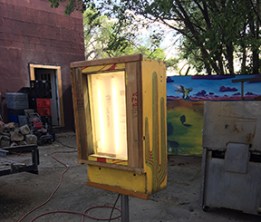
Skillet Casting its Culinary Magic

From the Skillet website: Sometime in 2012, Isaac Sandoval was challenged to design and build the world’s largest cast iron skillet. The skillet itself didn’t break any world records but people loved the unique menus and crowd-pleasers cooked in the giant skillet. Thus, began the journey into food and pure wonderment of all things culinary. Isaac and Shawna set up shop in Vegas (NM) as a food truck, and two years ago went full brick and mortar in a historic building downtown. Skillet today is an immersive art, food, and drink experience.

How did they navigate the restrictions imposed by COVID-19? Below are Shawna’s responses to questions about the virus and its impact.

Artfully designed
The foodie entrepreneurs have not been idle during their down time. The Zen pool and new artwork are just some of the additions to the patio. That’s Shawna in the background.

“We were forced to close our doors March 15,” Shawna said. “Ourselves and our employees all went on unemployment directly after. Although the government left opportunity for restaurants to serve takeout, we made the decision that our efforts were best placed elsewhere.”

The fan-favorite foodie-friendly restaurant was closed for two and one-half months, reopening on June 1.

Shawna said the Skillet is reopened at 50 percent capacity because of mandates from health officials. “Our business hours are basically the same as before. We decided to cut our late-night menu for the time being, which so far gets us home earlier on the weekends.”

Looking to the future early on in the shutdown, the Sandovals set about making changes designed to add and enhance seating, and expand food options.

“We expanded our patio seating during the quarantine knowing that outdoor dining is considered substantially safer than indoor dining. Skillet has a large outdoor patio and our outdoor occupancy at 50 percent is 100 people. With the recent beautiful weather, Pizza anyonewe’ve been serving more customers outside, which was made possible because of the expansion. Our order-at-the-counter service is actually conducive to the “contactless” approach. We eliminated all duplicate menus and have just one menu for customers to see without touching, and our servers still bring all food and beverage to the customer. We have security staff for busy nights who remind people to sign our book at the door for the required contact tracing. Recently we’ve implemented digital temperature readings for all customers entering the restaurant. Employees that are in direct contact with the public are required to wear masks at all times.”

Like many businesses, the Skillet has taken advantage of stimulus programs geared toward small businesses.

“Through the Paycheck Protection Program (PPP), we are able to rehire and pay all our employees who went on unemployment for the quarantine. The grant portion of the loan will assist with our payroll while the business is getting back on its feet. This is particularly beneficial for restaurants such as ours as we employ around 20 people, a significant proportion of our operational costs.”

Operations day-to-day requires attention to detail and a willingness to work toward specific goals. Shawna and Isaac want to return to – and continue – the ambiance and atmosphere the Skillet has become known for. The young entrepreneurs are equally concerned about their business friends and neighbors.

Art Installation“In spite of uncertain times, we fully intend to provide the same fun and safe environment as we always have,” Shawna said.

“Please continue to spend money at local businesses in our community; our friends and neighbors have been more than gracious and we need to do everything in our power to make sure Las Vegas continues to thrive.”

Isaac and Shawna aren’t worried about the future so much as ready for new challenges. “As a relatively new business we are already accustomed to constantly evolving and changing things in our business per the market and trends. The COVID restrictions are just another hurdle to jump for us, although this is a difficult time for everyone, our newness works to our advantage.

“It’s one day at a time for now,” Shawna said. “This will most certainly change us and all restaurants in small ways forever, however, I remain optimistic with regards to the outcome.”

For more information about the Skillet, go to giant-skillet.com


Courtesy Photos: The Skillet


NOTE: I am featuring local businesses, nonprofits, and organizations in this series of articles about how COVID-19 has affected our community . If you would like to participate, email fsharon@msn.com for more information.


Las Vegas NM Community Foundation

Note: This is the first in a series of articles about how businesses, nonprofits and event planners are navigating the future post-COVID 19. Partial reopening is a first step, and there is no predicting the future should there be a resurgence of corona virus. Responses to these questions are from Elmo Baca, president of the Las Vegas NM Community Foundation.


Community Foundation

The Foundation and Its Mission

The Las Vegas NM Community Foundation was founded in January 2017 by Bob Mishler along with founding board members Felix Alderete, Elmo Baca, Cindy Collins, Doyle Daves, Bill Hendrickson, Donna Rivas, Jennifer Sanchez and Max Trujillo. Founding volunteer Jean Hill assisted with non-profit by laws and designation. The Las Vegas Foundation is a 501©(3) charitable organization created to support philanthropic giving for non-profit organizations in Las Vegas and the immediate region, including Mora County. The Las Vegas Foundation is an affiliate and partner of the Santa Fe Community Foundation, where Las Vegas Community Foundation funds are currently invested, ensuring the highest fiscal and programmatic integrity to its work. The mission of the Las Vegas Foundation is simply “Help Las Vegas Thrive.”

How has COVID-19 had an impact on the Foundation?

The coronavirus pandemic has had an impact in a few critical ways. After the state effectively closed businesses and other public venues in late March, the Board of Directors decided to postpone the “Chili Challenge” annual fundraising reception which was scheduled for April 30. Last year the Chili Challenge (so called because a chili pepper icon is used as a measuring gauge for donations) was well-attended by community members and raised over $17,000 to benefit the community. At this date the Chili Challenge event has not been rescheduled due to the continuing restrictions on public gatherings in New Mexico. After the serious economic impacts of the pandemic have mounted, the Foundation created an Emergency Grant Fund to provide support to local humanitarian nonprofit organizations, such as soup kitchens, health and community centers, and family assistance groups. The Las Vegas Foundation has had two rounds of grant making since April funding a dozen local non-profit organizations in Las Vegas, Mora and Villanueva with $10,125 in grants. The Foundation is prepared to consider future rounds of emergency grants as the pandemic continues to impact the community.

Bob Mishler’s Legacy

Bob MishlerThe sudden passing of founder Bob Mishler on May 24 was a tragic event that has affected the entire community, as Bob was involved in many projects and organizations. Bob had a great interest in people, their histories and social fabric. He was involved in historic preservation projects for nearly 50 years after his family moved here from Colorado in the late 1970s. He served for many years as Chairman of the City’s Design Review Board, Citizens Committee for Historic Preservation and the Friends of the Las Vegas Museum. Bob saw the need for Las Vegas to have a community foundation that could create an endowment for Las Vegas to support the vital work of nonprofit organizations and also collaborate with city and county governments on essential community projects. Bob worked tirelessly to attract volunteers and board members to the Foundation, raise funds, and provide its guiding vision. He was active in a review of an Emergency grant application on the day of his passing.

Eligible Grantees

The Las Vegas NM Community Foundation provides modest grants to local nonprofit organizations in good standing (properly filed corporate reports and tax forms). Eligible nonprofit organizations must serve the people of San Miguel and Mora Counties, be nondiscriminatory in staffing and services, and be at least one year old. The Foundation can’t contribute to capital campaigns or endowments, individuals, private school tuition assistance, religious projects or scholarships. The funding categories include Arts and Culture, Community Development, Cultural and Historic Preservation, Education, Health Care and Natural Conservation.

Application Process

The Las Vegas NM Community Foundation has offered grants to nonprofits for the past two years and is expecting its third annual cycle beginning in September with a public announcement of grant availability. Grant applications are available by emailing info@lvnmcf.org . We also notify nonprofit organizations directly via email of our grants program. Grant applications are due in mid-October, with announcement of awards in December. Funds are provided in early January. Also, as noted above, the Foundation may create emergency or project grant cycles at its discretion. Interested groups may see our website at www.lvnmcf.com, contact a Board Member or contact our Administrative Coordinator Linda Anderle at info@lvnmcf.org. Correspondence and donations may also be mailed to LVNMCF, P.O. Box 1002, Las Vegas NM 87701.

Fund Raising Campaigns

With Bob Mishler’s sudden passing on May 24, the Board of Directors has established two Bob Mishler Memorial Funds in his memory. The Bob Mishler Memorial Fund is a general donation fund with a primary purpose of building the endowment, as Bob had wished. The second fund is called the Bob Mishler Memorial Clock Fund. Bob rescued the historic Gordon’s Jewelers cast iron street clock, which stood on Douglas Avenue near the corner of Sixth Street for decades. After the passing of longtime owner Calvin Baker, the iconic street clock fell into disrepair. Bob bought the clock with the intention of restoring it. Bob had nearly finished the project when he passed. The Board of Directors have recognized the clock project as a fitting symbol for Bob’s community service and his philanthropy. The Clock Fund will provide the financial support to restore the clock and reinstall it. The Clock Fund will also create a “Pillars of the Community” Award program to honor deserving individuals who have made significant contributions to the community.

The Board of Directors is also considering Donor advised funds whereby generous individuals or families may support projects and programs of particular interest such as the arts or health care for example. Legacy gifts of property, financial equities, and other items of value to benefit the community are also encouraged. Donations may be made at www.lvnmcf.com and also through the Santa Fe Community Foundation by inquiring about the Greater Las Vegas Fund.


NOTE: I am featuring local businesses, nonprofits, and organizations in this series of articles about how COVID-19 has affected our community . If you would like to participate, email fsharon@msn.com for more information.


And now for the next adventure

Yes or No

I’m in that battling through ideas stage, wondering what thread of excitement engages me enough to begin story development. It sounds easier than it is. Some ideas will be best expressed as poetry, others as a short story and others in a novel.

How does one get past the muddled mess and move forward? Here are five questions to help you determine how you want your inner storyteller to tell the tale.

Is this a story with interwoven plots and subplots?

  • Complex stories can be told in any form, including poetry. Think of The Iliad by Homer, a marathon Greek poem about the Trojan war, or Caged Bird, by Maya Angelou, a story about freedom. Could these tales have been told in a different way? Probably, but not as poignantly. That said, if you have a story that’s deep and wide, consider writing a novel, or at the very least, a novella. You have more time and space for compelling characters and intriguing plots.

Is this story a shovel or a knife?

  • A shovel digs deep and uncovers what is hidden; a knife is more precise and goes to the central theme without a lot of lead in. Deep is best handled in a novel; precision in a short story or poem. O. Henry was the master of short form writing with satisfying – often unexpected – endings. Remember The Gift of the Magi?

What audience is the story geared toward?

  • I don’t like to bring it up, but yes, you do need an audience for your work, no matter what you write. Children’s books are written in a certain way for very good reasons. Consider carefully the profile of your reader and forge ahead accordingly. One of my favorite authors is David Baldacci.  This is a writer who knows his audience and creates powerful characters in compelling situations. His novels sell worldwide and have been translated into many languages.

How much do you love your idea?

  • Writing a story is a process. The seed is just that, a seed. For it to grow into something that will inform and entertain requires nurture (creativity), weeding (editing), and feeding (revising).

But – as writer and literary agent Lisa Cron would ask – how much do you know about your  character before you push him or her onto page one of your novel?

  • Cron, the author of “Wired for Story” encourages writers to understand their protagonists’ deeply and well before proceeding. This isn’t pre-writing; it’s exploring the lead characters backstory so, as the author, you know going in the “inside intel” that drives the character and mucks up his or her life as they make their way forward. It sounds easy, does it not? Well, it isn’t. It is probably the most difficult thing a writer must do. Is it worth the effort? Cron says, yes, citing authors in her acquaintance who – by way of this process – went from rejection to seven-figure book sales.

My stumbling block is focus. To write, one needs to set everything else aside an focus on the goal, and be willing to do the work.

Back to basics. Who is my story about? What does she want? What does she fear that will keep her from achieving that goal? How can she overcome her fear and succeed? Therein lies – THE STORY.

Wish me luck!


I am an indie author of six books and two chap books of poetry. Check the BOOKS tab to find out more. Follow me at www.vandermeerbooks.com, https://www.facebook.com/vandermeerbooks, Amazon Author Central



KINDNESS

Be Kind


In an unsettled and unsettling time,
when life’s surprises can turn on a dime,
we look to each other for reasons to smile,
to leave fretting and worry behind for a while.

Tomorrow has never been certain;
it hides behind Future’s opaque curtain.
Be thankful you have this day,
to be kind to others along life’s way.

Give when you can in this murky rift,
to help those who are suddenly adrift,
cast into the darkness of what’s next,
their hearts and minds equally vexed.

Kindness does not resolve fears;
it can wipe away worried tears,
giving for a moment, a little relief,
restoring, hope, trust and belief.

In an unsettled and unsettling time,
when life’s surprises can turn on a dime,
we look to each other for reasons to smile,
to leave fretting and worry behind for a while.


Follow Sharon at:
www.vandermeerbooks.com
https://www.facebook.com/vandermeerbooks
Amazon Author Central


Day 132

Alone

Abigail rose from the tangle of blankets, wringing wet. The bedding reeked with her sweat. She staggered to the window, chilled less by a limp breeze, more by what she would see when she looked out.

The barren street mocked her.

She rubbed her thin arms and turned away from the emptiness: empty cars that would never go anywhere again; empty benches where no one sat; empty sidewalks devoid of walkers. The worst? Lack of noise. No screaming sirens, wailing babies, horns honking aggressively, people arguing, the swish of skirts and click of high heels; coughs, snorts, sneezes and wheezes. Laughter. Nothing.

Simply silence.

She grasped the handle of a pan and threw it across the room just to hear the sound as it hit the wall. It thudded unsatisfactorily and clanged unconvincingly when it hit the wooden floor.

Abigail had selected the apartment for the view out the window. The pandemic that wiped out the world population, apparently leaving her the single survivor, had driven people from the neighborhood looking for safety somewhere; anywhere. The stench of death didn’t hover here, as it did in many places she’d encountered in her search for other survivors.

She was it. There were no others, not one.

She picked the pan up from the floor and returned it to the counter, setting it down with more force than necessary, just to hear the sound.

She’d had her pick of places to settle in. The complex she’d chosen wasn’t fancy but it was well-maintained. The studio apartment was on the second floor, facing the street. The higher you went, the better the view and the more expensive the rent. That didn’t matter anymore.

Her selection of the studio apartment came down to one thing – apart from the view; it was the only apartment on the second floor facing the street that stood open. All the other doors were closed tight and locked even tighter. Whoever had lived in 227 B had left in a hurry.

In her wanderings, before arriving at 227 B, Abigail had seen a perplexing mix of evidence that humanity was crazy as hell. She had heard – when communications networks were still functioning – that as bodied piled up in make-shift morgues, people went nuts, burning, looting, killing. Entire neighborhoods were decimated by violence. If the creeping, killing virus didn’t get you, the guy next door might, probably would, and then he’d steal you blind, rape your wife, kill your kids. You gave up trying to decide who was friend or foe. Survival meant you trusted no one.

Now there was no one left. Trust was no longer an issue, was it?

Abigail had plenty of food, most of it in cans with tab-top openers. For the cans that didn’t have tab tops, she had found a manual can opener at a trashed hardware store. At first, she left money on the counter when she took something, until she ran out. By then she’d come to realize she was the only one left.

Why?

It was a recurring and unanswerable question. Everyone in the world – as far as she knew – was gone. Dead. Until she’d come to this town, this neighborhood and settled in 227 B, the stench of rotting corpses had clung to her hair, her clothes, her body. She’d left death behind and was glad to be rid of it.

In her heart she believed – hoped – there were other survivors, but where? In this town, state, country? How did she find them? In the beginning, she’d taken cars abandoned along roadways, driven them until they ran out of fuel and then commandeered another one, searching always, honking the horn, hoping someone would run into the streets to flag her down; to say, “Here! Here! I’M HERE, YOU’RE NOT ALONE!”

But it hadn’t happened.

Yet.

She hadn’t given up hope.

Yet.

And if she came upon someone? What then?

Trust no one. Her mother’s dying voice rang in her head during the day and haunted her dreams at night.

The apartment, at least for the moment, had running water and electricity. The appliances were electric and in working order. If she didn’t know bone crushing loneliness, she would be fine. How long everything would continue to function was something Abigail chose not to think about. She was okay for now, and now was all the mattered.

The apartment also had the advantage of being small, which suited Abigail very well. Despite knowing she was alone, she was terrified of potential unknowns that lay beyond her door. When she was in the apartment, she set the deadbolt and for insurance, lodged a chair back under the knob to prevent anyone from entering. For added protection, she kept an archery set close by. She’d found it in a sporting goods store and taught herself how to use it. It was a skill she practiced every day so it became an extension of who she was.

Abigail went out every day, bow and a quiver of arrows strapped rakishly over her shoulder. She did not walk openly in the empty streets. She skittered down back alleys, looking for anything she could use to survive. Stores of any kind that had battered down doors were fair game. She pilfered from a Walgreens, stocking up on bandages, over the counter meds, makeup (why makeup she didn’t know; she never used it), paper goods and nonperishable foods, books, magazines, batteries, anything that she could use to make her life bearable. There was also a neighborhood grocery store, not one of the chains, but well-stocked, although the fresh meats, fruits and vegetables had long ago gone bad, the bread products moldy or rock hard. She took sparingly from the freezers, hoping they would last as long as the food in them did. She stocked up on clothing that spanned the seasons, sensible shoes, practical and sturdy. She took what she could, day-by-day, stacking it up outside the apartment when she ran out of space inside 227 B.

How much would she need? She didn’t know, but she didn’t want to find out by not having enough.

Some days she would ask herself, “Why bother? Why not just roll over and die, take the still-functioning elevator to the top floor of her 24-story building and fling herself off the roof? She didn’t know why, but she was determined to survive.

Her restless night clung to her as she put on distressed jeans, found in a trashed boutique; $200 price tag, more than she’d spent on clothes in a year in the time before. She slipped a hoodie over her T-shirt and stepped into her favorite tennis shoes. It was a chilly day, early signs of fall in the air.

As she walked along, she wished she’d stayed in the apartment as she trundled her pilfered shopping cart down the alley, packed full of her finds. She hummed some half-remembered song from her youth to keep herself company.

“HELLO! HELLO! ANYONE? ANYONE?”

Abigail froze.

“HELLO? ANYONE THERE?”

Where was the voice coming from? Abigail darted her eyes side-to-side, not looking for the owner of the voice; she sought instead a place to hide.

Male? Female? She couldn’t tell. The voice was raspy, raw from yelling, as hers had been when she screamed and screamed the same unanswered greeting for days on end.

“HELLO! ANYONE THERE?”

The voice was coming closer. Trust no one.

Abigail quaked. What was she to do? She scurried down the alley like a frightened mouse and hid behind a dumpster that had never been emptied; its sour smell stagnated by time.

Footsteps approached, the sound plodding and dreadful.

Trust no one. Abigail swallowed a gasp of fear  and squeezed her eyes shut, as if she could shut out approaching doom.

“Well, well, well. What have we here?”

Abigail swallowed a sob and opened her eyes expecting something – someone – to be leaning over her.

“Looks like somebody’s been shopping.”

Abigail dared to peek around the edge of the dumpster. A woman, if the long brown hair was an indicator. Still, it could be a man, which worried Abigail. A man would take over. Steal everything, leave her with nothing, maybe not even her life.

The figure rummaged around in the cart and pulled something from the carefully arranged stacks. A Payday. Abigail’s favorite. For one foolish second she thought to leap from her hiding place and snatch the candy bar from the intruder.

Intruder? Isn’t this what she’d hoped for, another survivor, someone to share the burden of survival with her? But she remained still.

“What do you think of that, Chloe?” The voice asked.

Definitely a woman. Who the heck was Chloe? Abigail leaned further around the edge of the dumpster to see if there was another person there. No one, just the woman eating her candy bar.

“I think we found home, Chloe. What do you think?”

Dead silence.

“I agree. Now we have more provisions to add to the store we already found. Let’s go home.”

She started pushing the cart quickly down the narrow alleyway.

Trust no one.

Abigail knew then that she’d been found, that this greedy woman was taking over her life. She wasn’t about to let that happen. She rose from her hiding place, an arrow already notched in place and let it fly just at the woman turned and fired a gun point blank at Abigail, as though she’d known all along where she was hiding.


I am an indie author of six books and two chap books of poetry. Check the BOOKS tab to find out more. Follow me at www.vandermeerbooks.com, https://www.facebook.com/vandermeerbooks, Amazon Author Central


Dance Today; It’s Okay

DanceDelight yourself in the Lord and he will give you the desires of your heart. Psalm 37:4

Dance today. It’s okay. God knows your joy. Remember its source. He knows your fears, your sorrows, your fury, your confusion. The Lord of all walks with you and lives in you. He is not a distant and unconcerned God; He is the God of possibilities; He is the God of the impossible. Let him in. Take comfort in his presence.

“How can I?” you ask, “My home was washed away in a massive flood!”

“How can I? I lost my job!”

“How can I? My husband/wife left me!”

“How can I in the middle of a pandemic?”

“How can I when racism rages?”

How can you not? The anchor in every storm is the assurance of God’s presence. Studies have shown that those who lean on their faith are more likely to overcome troubling times. Dance, even when the dance is one of sorrow or disappointment or anger. Even in those times know God is present, not to fix what’s wrong, but to give you strength.

Dance on the flames of hate until they are stamped out. Dance so justice is served. Dance so the dying embers of hope spark anew. Dance in memory of innocent men, women and children everywhere.

The music of life is a curious thing and a reminder that we are never alone in our dance. The spirit of hope and the hammer of faith give us strength, wisdom and helpers along the way. We aren’t forgotten even when we forget. God’s love for us is as real as the breath we take in and the breath we let out. God doesn’t care what color we are, what language we speak, the way we worship Him – or not. I believe God is color-blind but very attuned to the melody of renewal.

Dance. The band is in full swing. “You will go out in joy and be led forth in peace; the mountains and hills will burst into song before you, and all the trees of the field will clap their hands.” Isiah 55:12


I am an indie author of six books and two chap books of poetry. Check the BOOKS tab to find out more. Follow me at www.vandermeerbooks.com, https://www.facebook.com/vandermeerbooks, Amazon Author Central


Isolation

Kafka

Isolation is a way to know ourselves. Franz Kafka
The arts don’t exist in isolation. David Byrne

We’ve been in forced isolation because of this pandemic. Some don’t mind it at all; others chafe under the restrictive boundaries. It isn’t just the “staying home” edict that grinds. Mask-wearing has, for some, become a line in the sand. Personally, I don’t like them but if by wearing a mask I protect others, I’m okay with masking up.

Not interacting with others is a bit more of a challenge. I like people. Although I’m inclined to fade into the background, I still want to hear what others have to say, even when I don’t agree with them.

Kafka – a man full of self-doubt about the thing he most valued, his writing – perhaps sought isolation to better understand who he was and how the complications of his life shaped him. A tyrannical father, the deaths of siblings when he was young, a mother who loved being a homemaker but who didn’t quite know what to do with an intellectual child who would become more so over time. These factors affected his relationships and colored his work. Interestingly, little of his work became known during his lifetime. Were it not for his friend Max Brod, his unpublished manuscripts would have been destroyed.

I’m inclined to agree with David Bryne (Talking Heads), identified by Time Magazine in 1986 as Rock’s Renaissance Man: “The arts don’t exist in isolation.” According to the Time article, Byrne enjoys success as a singer, composer, lyricist, guitarist, film director, writer, actor, video artist, designer, photographer. Always engaged in creating art.

These very different men identify with isolation from perspectives based on their own experiences, and most certainly through the lens of the eras in which each live(d). Bryne works in collaboration with others to bring art to the masses in different forms. Kafka, although a genial fellow in certain circumstances, was so haunted by self-doubt about his writing, he asked his good friend to destroy his work after Kafka died.

Isolation 2020 will have repercussions on society that are yet to be determined. The impact of COVID-19 on those who lost family and friends is incalculable. The economy reels and will continue to do so for some time. The emotional toll will emerge slowly, catching us unawares, showing up in unexpected ways.

Kafka was a pessimist and probably for good reason. He lived in scary times. If you want a nightmare, read Metamorphosis. His work is overall bleak. Byrne on the other hand appears to be the ultimate optimist. He confesses to being “mostly” happy.

In the days ahead (weeks, months, years?), we have a choice to make: be an optimist or a pessimist. I don’t think there is a middle ground. Pass on your optimism to those around you. If you must be a pessimist, find people who know you well enough to help you see the up side, even when it feels like there isn’t one.

To say the future is a bit wobbly around the edges isn’t being a pessimist; it’s seeing the world for what it is and doing what you can to make it better. Two things you can do – optimist or pessimist: VOTE and fill out your census form. See, that isn’t hard!


I am an indie author of six books and two chap books of poetry. Check the BOOKS tab to find out more. Follow me at www.vandermeerbooks.com, https://www.facebook.com/vandermeerbooks, Amazon Author Central. Please like, share, or comment – or all three!


TRUST

Trust


Bring peace and justice
in equal measure.
Give hope to hearts
broken by hate and fear
so we become alike it this:
we are equal,
we are the same.
Trust sets the standard
for how we live,
giving feet to faith,
hands to helping,
bringing joy to hearts.
In all and with all
we see His promise,
taking us from fear to clarity,
from fury to assurance.
Trust opens doors to possibility.
Break the barriers between us
so we see each other
for who we are,
not the color of our skin –
equal, the same.


Follow Sharon at:
www.vandermeerbooks.com
https://www.facebook.com/vandermeerbooks
Amazon Author Central


Mr. C Returns

Quick Fact

Mr. C is back and has taken up residence in my bladder. I know, TMI, but I’m sharing this information because bladder cancer is one of the most common cancers in the U.S., affecting about 68,000 adults each year. According to the Mayo Clinic website, it occurs more often in men than women. I appear to be one of the lucky women who has it. Bladder cancer can happen at any age, but it is more common in older adults. I’m 75, prime time.

Early detection – as is often the case – means treatment is likely to be successful. Someone asked me what stage the cancer is. You’d think I would know, but I don’t. I start treatment next week, one a week for six weeks, followed by two years of treatment, one every three months. With bladder cancer, frequent monitoring is a must as it – as my doctor said – is unlikely to go away permanently. The best course of action is vigilance.

The first procedure, before the treatment plan was determined, took place on May 6, delayed because of COVID-19 and the need for critical care facilities. The procedure determined the presence of tumors and the likelihood they were malignant. Further testing revealed there are tumors, and yes, they are malignant.

The good news is, I won’t have chemo; I’ll undergo an immunotherapy regimen, which is less intrusive and arduous than chemo. It is not without risk as the drug I will be taking contains TB cells, which creates a hostile environment in the bladder that prevents the cancer cells from growing. (I hope I got that right.) I won’t go into detail about what one must do once the drug is eliminated. Suffice it to say one must be VERY careful.

So, prayer is appreciated. No worrying allowed. I’m a tough old nut and have survived Mr. C’s other visitations to my body.

Because it is fairly common, I’m including some of the symptoms you might want to talk to your doctor about if you have them.

Bladder cancer signs and symptoms may include:
• Blood in urine (hematuria)

• Painful urination
• Pelvic pain

If you have hematuria, your urine may appear bright red or cola colored. Sometimes, urine may not look any different, but blood in urine may be detected during a microscopic exam of the urine.

People with bladder cancer might also experience:
• Back pain

• Frequent urination

Be well; stay healthy. As we age, it is ever more important to be alert to symptoms and see the doctor about concerns you may have. It – whatever it is – won’t magically go away, just because you want it to. It’s your health; be proactive. See your health care professional regularly.


I am an indie author of six books and two chap books of poetry. Check the BOOKS tab to find out more. Follow me at www.vandermeerbooks.com, https://www.facebook.com/vandermeerbooks, Amazon Author Central